

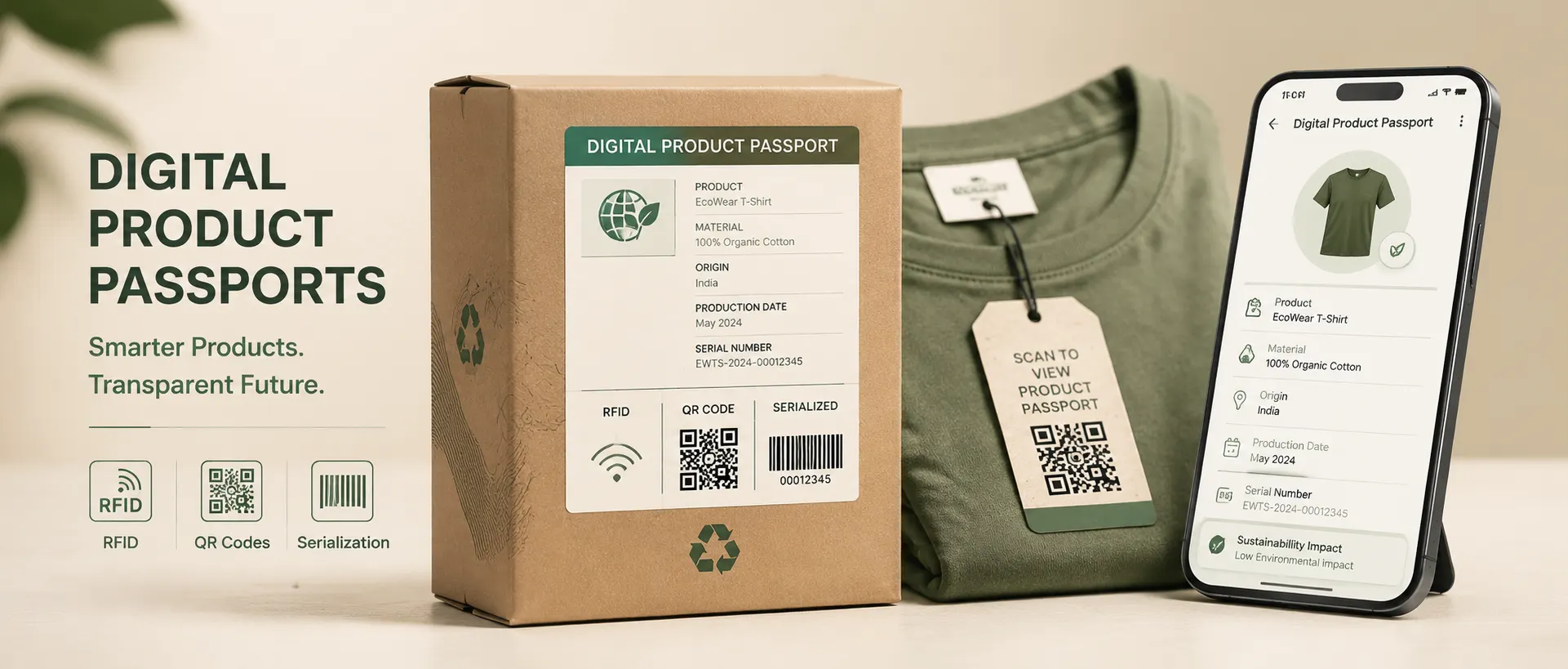
A digital product passport is a structured digital record tied to one physical product. It carries data on materials, origin, compliance, and end of life. RFID and QR codes carry the data that connects the physical item to that record. The EU made this a market access requirement under ESPR. Its central registry went live on July 20, 2026.
أهم النقاط
- A digital product passport links one physical product to one digital record. It uses a unique identifier, such as a GTIN or serial number.
- The EU’s Digital Product Passport Registry launched on July 20, 2026. It became legally governed on August 6.
- RFID and QR codes are both valid data carriers under ESPR. Neither is mandated over the other.
- GS1 Digital Link is the standard behind this. It turns a barcode into a structured web link that resolves to the right passport.
- Batteries are first, required by February 2027. Textiles and electronics follow through 2027 and 2028.
What Is a Digital Product Passport?
A digital product passport is a digital record tied to a single product. It is not tied to a product category. It holds data on materials, manufacturing, compliance, and disposal. It stays linked to that one item for its entire life.
The European Commission opened its Digital Product Passport Registry on July 20, 2026. That is the central database storing unique identifiers for covered products. A companion regulation governing its operation took effect on August 6.
The registry going live does not mean every product needs a passport today. It means the infrastructure now exists. Product-specific rules, called delegated acts, determine when each category must comply.
Digital Product Passport Requirements: What ESPR Actually Mandates
Digital Product Passport requirements come from the Ecodesign for Sustainable Products Regulation, or ESPR, Regulation (EU) 2024/1781. It entered into force on July 18, 2024. It applies to nearly every physical product sold in the EU.
ESPR does not list exact data fields itself. It sets the framework, then delegates specifics to category-specific acts. Batteries got theirs first. Others are still being finalized.
What ESPR does require across the board: a unique product identifier, a data carrier linking a physical item to its digital record, and interoperability across systems. It does not require one specific technology. That choice sits with the business.
Digital Product Passport RFID: Why Enterprises Are Choosing It
Digital Product Passport RFID adoption is growing fastest in B2B settings. It fits high-volume supply chains best. RFID tags do not need a straight line of sight to scan. A reader can capture dozens of tagged products in one pass.
That matters at a warehouse dock door. It matters on a sorting line too. A worker scanning barcodes one at a time cannot keep pace with a moving pallet. RFID reads the whole pallet at once.
RFID also holds more data than most barcodes. It supports write-back too. A passport can get updated as a product moves through repair, resale, or recycling. It is not just read once at the point of sale.
Digital Product Passport QR Code: The Consumer-Facing Layer
A Digital Product Passport QR code solves a different problem than RFID. It gets a shopper from a physical tag to a webpage. Most people already carry the phone that reads it.
No special reader is needed, and in most cases, no app is required. QR codes are cheap to print. It works with a standard phone camera, making it the default for anything a consumer touches directly.
Scanning a hundred QR codes one at a time takes far longer than an RFID reader capturing a hundred tags in seconds. That is why QR codes sit at the consumer end of the chain. RFID handles bulk movement upstream instead.
Digital Product Passport with RFID and QR Code Together
Most real deployments do not pick one carrier. A Digital Product Passport with RFID and a QR code on the same product covers both audiences. The warehouse gets one, the shopper gets the other.
GS1 Digital Link is the standard making this practical. It turns a product’s existing identifier, its GTIN, into a structured web link. That link can live inside a QR code, a data matrix, or an RFID tag. It resolves to the correct passport, no matter which carrier scanned it.
That single detail solves a real problem. Without it, a business would need separate systems for consumer QR scans and warehouse RFID reads. GS1 Digital Link keeps both pointed at the same data.
Serialization: The Layer Underneath Every Passport
None of this works without serialization first. Serialization means every unit gets its own unique identifier. It is not just a category-level number.
A GTIN identifies a product type. It is the same number on every unit of one SKU. A serial number identifies one specific unit of that SKU. A passport needs both, because the EU requires item-level traceability, not just category labeling.
Getting serialization right at the production line takes real system work. Printing or encoding a unique ID on every unit is harder than choosing between RFID and QR code.
Who Needs One, and When
Not every product needs one yet. Rollout is staggered by category. The dates are fixed by regulation, not guesswork.
Batteries lead the way and are required by February 18, 2027. That falls under a separate Battery Regulation that predates ESPR. Textiles and footwear follow in the 2027-2028 window. Electronics, furniture, and construction materials are working through their own delegated acts on a similar timeline.
If your category has no delegated act yet, you don’t need to comply today. But the registry infrastructure is already live. Waiting until your deadline is close leaves little room to fix data gaps.
Choosing a System: What to Check First
Before picking a vendor or a data carrier, confirm these basics are in place.
- Serialization at the source. Every unit needs a unique ID assigned during production, not retrofitted later.
- A GTIN already in use. If your products carry standard barcodes, you already have the base identifier a passport builds on.
- Data carrier fit for the audience. RFID for bulk warehouse movement, QR code for direct consumer access, often both.
- A system that updates, not just stores. A passport tracks a product’s whole life, so the record has to accept new data over time.
- Supplier data readiness. Material and sourcing data often comes from partners, not just your own systems.
How DCS Builds Digital Product Passport Infrastructure
DCS’s نظام تتبع المنتجات وإدارة الضمان already does the core work a passport needs. It assigns a unique ID per unit and tracks it from production through its service life. Extending that into a passport format is a data structure change, not a system rebuild.
For the data carrier layer, DCS deploys تحديد الهوية بموجات الراديو where bulk scanning matters. It uses barcodes for operational identification and QR codes where direct consumer access to product information is required. Often, both technologies are used on the same product line. DCS’s AIDC approach treats them as parts of one identification layer rather than competing technologies.
A GCC manufacturer exporting to the EU worked with DCS to add serialized tracking at the production line, ahead of its category’s compliance deadline. Retailers preparing for textile and footwear rules can see how DCS’s retail solutions already handle item-level tracking at scale.
Want to check if your product line is ready for serialization? Contact the DCS team.
Common Mistakes to Avoid
- Waiting for the deadline to start. Serialization changes take longer to implement than most teams expect.
- Picking RFID or QR code as a permanent choice. Most products end up needing both, for different audiences.
- Treating it as a labeling project. The harder work is the data behind the label, not the tag itself.
- Assuming suppliers already have the data. Material and sourcing data often has to be requested and verified first.
FAQs on Digital Product Passport
Is a digital product passport required for all products right now?
No. Only product categories with a finalized delegated act have a compliance deadline. Batteries are first, required by February 2027. Most other categories are still pending specific rules.
Does ESPR require RFID specifically?
No. ESPR requires a data carrier and a unique identifier, but it does not mandate one technology. Businesses can use RFID, QR codes, NFC, or a combination, as long as the carrier meets interoperability standards.
What is the difference between a GTIN and a digital product passport?
A GTIN identifies a product type. A digital product passport is the full record tied to one specific unit of that product, using a serial number alongside the GTIN for item-level tracking.
Can a small business comply with digital product passport rules without RFID?
Yes. QR codes are far cheaper to deploy and work for most consumer-facing compliance needs. RFID becomes worthwhile mainly at higher volumes or complex supply chains.
Where is digital product passport data actually stored?
The EU’s central registry stores identifiers and required registration data, not full product records. Detailed product data stays with the manufacturer or a DPP service provider and links back to the registry.
