

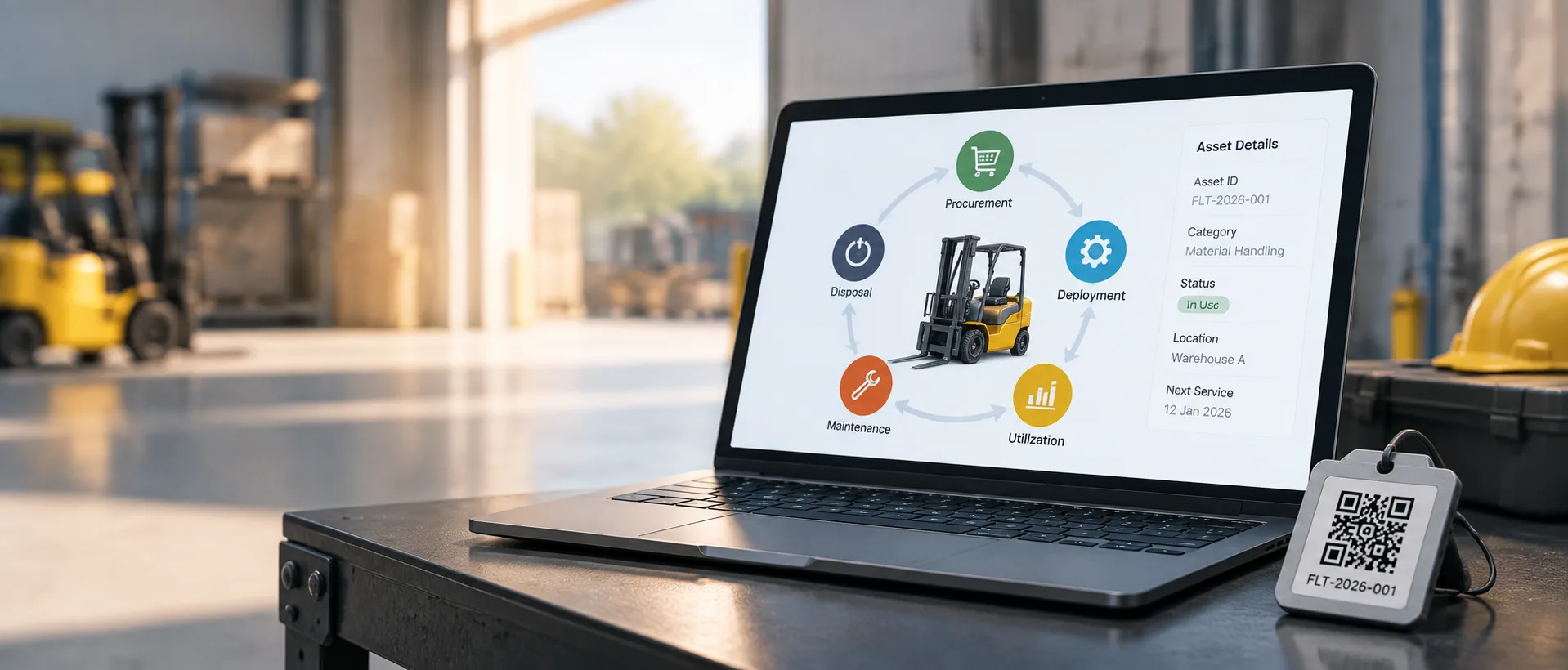
A business may have thousands of assets spread across offices, warehouses, plants, hospitals, vehicles, or field locations. If asset information is maintained across spreadsheets, paper records, and separate systems, even simple questions can become difficult to answer: Where is the asset? Who is responsible for it? When was it last serviced? How much has it cost to maintain? Is it still worth keeping?
This is where asset lifecycle management (ALM) becomes important. It provides a structured way to manage an asset from planning and acquisition through deployment, operation, maintenance, and eventual retirement.
For asset-intensive organisations, the objective is not simply better record-keeping. A well-managed lifecycle can improve asset visibility, support maintenance planning, control costs, reduce avoidable downtime, and provide better information for replacement and investment decisions.
أهم النقاط
-
- Asset lifecycle management tracks an asset from planning and acquisition through operation, maintenance, and retirement.
- Good asset decisions depend on accurate information about location, condition, usage, cost, maintenance, and performance.
- EAM systems provide a centralised view of assets, rather than relying on disconnected spreadsheets and manual records.
- Technologies such as barcodes, RFID, BLE, and mobile devices can improve asset visibility and tracking of movement.
- Proactive maintenance helps organisations reduce unexpected failures, control maintenance costs, and extend asset life.
- DCS provides EAM, asset tracking, integration, and implementation capabilities for organisations across the GCC.
What Is Asset Lifecycle Management?
Asset lifecycle management is a structured approach to managing an asset throughout its entire useful life.
Instead of treating acquisition, maintenance, and disposal as separate activities, ALM integrates them into a single continuous process. The organisation maintains relevant information at each stage so that decisions later in the asset’s life are based on actual data.
For example, information collected when an asset is purchased can later help with warranty management, maintenance planning, depreciation, replacement decisions, and final disposal.
In simple terms, ALM helps answer four important questions throughout an asset’s life such as:
- What assets do we have?
- Where are they and how are they being used?
- What does it take to maintain them?
- When should we repair, replace, or retire them?
What Are the Stages of the Asset Lifecycle?
The exact number of stages can vary by organisation, but most asset lifecycle management processes cover the following stages:
1. Planning
The process begins by identifying why the organisation needs an asset and what it needs that asset to achieve. Budget, operational requirements, expected usage, and long-term needs should be considered before procurement.
2. Acquisition
Once the requirement is established, the organisation selects and purchases the asset. Important information such as vendor, purchase cost, warranty, purchase date, and financing details should be captured at this stage.
3. Deployment
The asset is installed, configured, tagged, assigned to its location or user, and prepared for operation. Capturing its initial condition and configuration creates a useful baseline for future maintenance and performance reviews.
4. Operation
The asset enters its working life. Its location, utilisation, condition, performance, and movement can be monitored to understand whether it is delivering the expected value.
5. Maintenance
Maintenance activities are planned and recorded throughout the asset’s operational life. Preventive or condition-based maintenance can help identify potential issues before they result in unexpected failures.
6. Retirement and Disposal
Eventually, an asset may become too expensive to maintain, reach the end of its useful life, or no longer meet operational requirements. Retirement involves deciding whether to replace, reallocate, sell, recycle, or otherwise dispose of the asset while maintaining the required financial and compliance records.
Why Is Asset Lifecycle Management Important?
ALM helps organisations move from reactive asset management to a more planned approach, giving teams better visibility and control throughout an asset’s lifecycle.
- Organisations can maintain clear records of assets, including their location, condition, ownership, and status.
- Maintenance history and asset condition can help teams plan servicing and control avoidable maintenance costs.
- Proactive maintenance can reduce unexpected failures and help keep critical assets available.
- Regular maintenance and better utilisation can help extend the useful life of assets.
- Asset condition, performance, utilisation, maintenance costs, and depreciation can support better replacement decisions.
- Tracking asset movement and ownership can improve accountability and reduce the risk of misplaced assets.
DCS’s EAM solution supports this approach through barcode, RFID, and BLE-based asset identification, movement tracking, and depreciation reporting, helping organisations maintain better visibility and control over their asset portfolios.
What Is an Asset Lifecycle Management System?
An asset lifecycle management system is software that brings asset information, workflows, maintenance activities, and reporting into a central platform. Instead of maintaining separate records for procurement, maintenance, finance, and operations, an EAM system can link these activities to a single asset record.
A typical system can help teams:
- Create a centralised asset register.
- Record acquisition and ownership information.
- Track asset location and movement.
- Schedule and record maintenance.
- Maintain repair and service history.
- Monitor utilisation and performance.
- Generate depreciation and cost reports.
- Manage approvals for asset movement or disposal.
- Maintain records for audits and compliance.
- Integrate asset information with existing enterprise systems.
DCS’s EAM platform supports barcode, RFID, and BLE-based asset tracking, configurable approval workflows, Active Directory integration, and integration with ERP platforms such as SAP and Oracle.
How RFID, Barcode and BLE Improve Asset Tracking
Asset lifecycle management becomes much more effective when asset information can be captured automatically rather than updated manually.
Different tracking technologies can be used depending on the environment and the type of asset.
- Barcode: Useful for straightforward identification and scanning during inventory, issue, return, or maintenance activities.
- RFID: Enables faster identification and movement tracking, including automated tracking through RFID gate portals.
- BLE: Can support location and condition visibility for assets that require more continuous tracking.
The right technology depends on factors such as asset type, movement, tracking accuracy, operating environment, and the required level of automation.
The important point is that tracking technology should feed useful information back into the asset management system. DCS’s EAM platform is designed to connect asset identification and tracking with asset records, movement management, reporting, and maintenance processes.
What Are the Best Practices for Asset Lifecycle Management?
Technology alone does not create an effective asset lifecycle programme. The organisation also needs consistent processes and reliable data.
-
Maintain One Reliable Asset Register
Keep core information such as asset ID, location, ownership, condition, purchase details, and maintenance history in a central system.
-
Capture Data at Every Stage
Do not wait until maintenance or audit time to update records. Information should be captured when assets are purchased, moved, serviced, reassigned, or retired.
-
Move Beyond Reactive Maintenance
Use preventive and condition-based maintenance where appropriate instead of waiting for equipment to fail.
-
Track the Right Metrics
Useful metrics can include asset utilisation, downtime, maintenance costs, mean time to repair, and total cost of ownership.
-
Define Replacement Criteria
Set clear criteria for when an asset should be repaired, replaced, reallocated, or retired. This prevents important decisions from being delayed until a breakdown occurs.
-
Connect Asset Data With Other Systems
Asset information becomes more useful when it can work with ERP, finance, procurement, maintenance, and operational systems rather than remaining isolated.
How Does Asset Lifecycle Management Support Different Industries?
The requirements of ALM vary considerably depending on the industry.
- التصنيع: Equipment availability, preventive maintenance, production continuity, and downtime reduction are major priorities.
- الرعاية الصحية: Hospitals need visibility into medical equipment, maintenance records, location, utilisation, and compliance-related information. DCS supports healthcare asset management alongside RFID-based clinical asset tracking.
- قطاع الطيران: Tool and equipment tracking can support maintenance workflows, accountability, and safety. DCS also provides asset tracking and EAM capabilities for aviation environments.
- نفط وغاز: Asset condition, maintenance planning, remote monitoring, and operational safety are particularly important in demanding environments. DCS offers asset management and condition-monitoring solutions for oil and gas operations.
- النقل والخدمات اللوجستية: Fleet, equipment, and operational assets need to be tracked across multiple locations and points of movement.
- Government and Utilities: Large asset portfolios require centralised records, maintenance planning, accountability, and reliable reporting.
DCS currently supports organisations across sectors including healthcare, manufacturing, aviation, oil and gas, hospitality, government, energy and utilities, and transportation and logistics.
When Should an Organisation Consider an EAM System?
An EAM system becomes particularly valuable when asset information is becoming difficult to manage through spreadsheets or separate systems.
It may be time to consider EAM if your organisation:
- Manages a large or distributed asset portfolio.
- Has frequent asset movement between locations.
- Struggles to maintain accurate asset records.
- Relies heavily on reactive maintenance.
- Finds it difficult to track maintenance history.
- Needs better visibility into asset costs and utilisation.
- Has multiple teams working with the same asset information.
- Needs integration with ERP or other enterprise systems.
- Spends significant time preparing asset records for audits or reporting.
The right system should not simply digitise existing spreadsheets. It should make asset information easier to capture, connect, analyse, and use for operational decisions.
DCS and Asset Lifecycle Management
DCS brings asset management, tracking, and enterprise systems together so organisations can manage assets throughout their lifecycle rather than maintaining separate records for each activity.
Its Enterprise Asset Management (EAM) solution covers assets from acquisition to retirement, with features such as barcode, RFID and BLE tracking, asset movement monitoring, depreciation reporting, approval workflows, Active Directory integration, and SAP and Oracle connectivity.
The wider DCS offering also includes software configuration, implementation, system integration, and post-implementation support. With 10,000+ product installations and more than 3,000 clients, DCS brings experience across asset tracking, RFID, IoT, and enterprise software deployments.
For organisations managing assets across multiple locations or departments, this approach creates a single, connected view of where assets are, how they are being used, what they cost, and how they are being maintained.
أفكار ختامية
Asset lifecycle management is ultimately about making better decisions throughout the life of every asset.
When asset information is accurate and connected, teams can move beyond questions such as “Where is this equipment?” and start answering more valuable questions: “Is it being used effectively? What is it costing us? When should we maintain it? And when is it no longer worth keeping?”
An EAM platform, supported by technologies such as RFID, barcode, BLE, and enterprise integrations, can bring these answers into one operational view. DCS helps organisations build that connected asset management environment across the GCC.
FAQs on Asset Lifecycle Management
What is asset lifecycle management?
Asset lifecycle management is the structured process of managing an asset from planning and acquisition through deployment, operation, maintenance, and eventual retirement.
What is the difference between asset management and asset lifecycle management?
Asset management can refer broadly to tracking and managing assets, while asset lifecycle management focuses on managing assets across every stage of their useful life, from acquisition to disposal.
What is an EAM system?
An Enterprise Asset Management (EAM) system is software that helps organisations manage asset information, maintenance, movement, costs, performance, and other lifecycle activities from a central platform.
Can EAM systems track asset location?
Yes. Depending on the system and implementation, asset location can be captured using technologies such as barcodes, RFID, BLE, GPS, or other tracking technologies. DCS’s EAM solution supports barcode, RFID, and BLE-based asset tracking.
How does asset lifecycle management reduce downtime?
ALM helps teams use maintenance schedules, asset condition, service history, and performance data to identify maintenance needs before failures occur, reducing avoidable downtime.
