

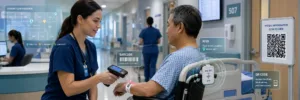
A patient tracking system in hospital settings identifies and locates patients automatically using RFID, barcode, or QR code technology, linking each patient to their record, medications, and location in real time. Barcode and QR codes verify identity at a fixed point, such as bedside medication, while RFID adds continuous location tracking across the building. Most hospitals combine more than one to cover both identity verification and physical patient flow.
Key Takeaways
- The Joint Commission’s National Patient Safety Goal 01.01.01 requires at least two patient identifiers before any care, treatment, or service, making accurate identification a compliance requirement, not an optional upgrade.
- Comprehensive barcode and electronic medication administration technology measurably cuts medication errors and adverse drug events, per research reviewed by the U.S. Agency for Healthcare Research and Quality.
- Patient tracking using RFID adds continuous, real-time location visibility, while barcode and QR codes confirm identity at a specific checkpoint.
- A hospital patient tracking system typically layers technologies: barcode for identity verification, RFID or BLE for real-time patient flow tracking.
- Hospital patient flow tracking exposes bottlenecks in bed turnover, transport, and discharge that manual logs catch only after the delay has happened.
- Newborn identification is one of the highest-risk use cases for a real-time patient tracking system, since infants cannot verbally confirm their own identity.
What is a Patient Tracking System in Hospital Operations?
A patient tracking system in hospital operations identifies each patient with a unique tag or code, then links that identifier to their medical record, medications, and location. Every scan or read updates the system, so staff work from current information rather than a chart last updated hours earlier.
Three components make it function. An identifier, printed as a barcode or QR code, or embedded in an RFID or BLE wristband, uniquely represents the patient. A reader or scanner captures that identifier during care. Software matches the read event to the patient’s record and, for RFID and BLE, plots their location, the same architecture behind a broader IoT tracking deployment. Removing any one component breaks the chain between the person in the bed and the record on the screen.
Why Does Accurate Patient Identification Matter This Much?
It matters because misidentification causes preventable harm with the right technology. The Joint Commission has required at least two patient identifiers before administering medications, collecting specimens, or providing treatment since naming this its first National Patient Safety Goal, and room number is explicitly barred from counting as an identifier since patients change rooms and beds.
The evidence for barcode-based verification is direct. A study reviewed by the Agency for Healthcare Research and Quality found that comprehensive barcode and electronic medication administration record technology cut non-timing medication errors by 41% and potential adverse drug events by 51%, with timing errors reduced by a further 27%. That result depends on scanning being followed consistently, since workarounds that skip the scan step erase the benefit.
RFID vs Barcode vs QR Code: Which Technology Fits Which Use Case?
The three technologies solve different problems, and most hospital patient tracking system deployments use more than one rather than picking a single winner.
| Technology | How it identifies the patient | Best fit | Limitation |
| Barcode | Line-of-sight scan of a printed wristband | Bedside medication, specimen labeling | Requires a direct scan at each checkpoint |
| QR code | Camera-scanned 2D code, readable on standard mobile devices | Check-in kiosks, patient portals, visitor logs | Same line-of-sight limitation as barcode |
| RFID / BLE | Radio signal read without line of sight | Continuous location tracking, infant protection, duress alerts | Higher hardware cost than barcode or QR |
Barcode and QR codes confirm identity at a single moment. Patient tracking using RFID extends that check into continuous location awareness, which barcode alone cannot provide. GS1, the global standards body behind barcode identifiers, is driving the Sunrise 2027 transition to data-rich 2D barcodes, with pilots running across 48 countries representing 88% of global GDP, letting a single wristband scan carry more identity and safety data than a legacy barcode.
What are the Main Use Cases for a Hospital Patient Tracking System?
Hospital patient tracking system use cases focus on where a missed identification step or location gap creates direct safety risk. Patient tracking using RFID covers most location-dependent cases below.
- Bedside medication verification. Scanning the patient’s wristband against the medication barcode confirms the right drug reaches the right person.
- Newborn and infant protection. RFID tags on mother and infant trigger an alert if the pairing is separated or an infant crosses a designated boundary without authorization.
- Surgical patient verification. Scanning confirms identity and procedure site before entering the operating room, reducing wrong-site and wrong-patient events.
- Specimen and blood transfusion matching. Barcode labeling ties a blood sample or transfusion unit to the correct patient at collection and again at administration.
- Emergency department triage tracking. RFID or BLE tags applied at intake let staff locate a patient instantly as they move between triage, imaging, and treatment.
- Real-time patient flow tracking. Location data from admission to discharge exposes where patients wait longest, informing staffing and bed-turnover decisions.
- Dementia and wandering-risk monitoring. RFID-tagged wristbands trigger a boundary alert if a confused or at-risk patient attempts to leave a designated ward.
How Does Hospital Patient Flow Tracking Improve Operations?
Hospital patient flow tracking improves operations by exposing exactly where a patient’s journey slows down, rather than leaving staff to infer it from complaints or missed targets. A real-time patient tracking system logs every transition automatically: admission, transfer, procedure, discharge, each timestamped and location-tagged.
That data answers questions a manual log cannot. Which department consistently holds patients longest before transport arrives. Whether a bed reported as available is actually clean and ready. Turning these read events into a usable operations dashboard is what separates a working system from a pile of location logs. Hospitals under staffing pressure depend on this visibility, since Gartner names smart hospital operations among the interconnected priorities healthcare CIOs must address in 2026, alongside AI, cloud, and data-sharing technologies.
Digital maturity tracks with safety outcomes more broadly. HIMSS research found that U.S. hospitals at advanced EMR adoption, EMRAM Stage 6 or 7, had 3.25 times higher odds of a top Leapfrog Group safety grade than hospitals at the lowest maturity stage. A real-time patient tracking system sits inside that same digital maturity layer, feeding the location and status data every other clinical system depends on.
What Should a Hospital Check Before Selecting a Patient Tracking System?
- Identifier compatibility. Confirm the system supports at least two identifiers per Joint Commission requirements.
- Coverage technology. Decide where barcode or QR verification is sufficient and where continuous RFID or BLE tracking is needed.
- EHR integration. Verify the system feeds location and identification data directly into the existing electronic health record.
- Infant and high-risk protocols. Confirm dedicated workflows exist for newborn pairing and wandering-risk alerts, not a repurposed asset-tracking configuration.
- Data privacy controls. Patient location data is protected health information once linked to an identity, so access controls and audit logging must match that sensitivity.
- Regional deployment support. For GCC hospitals, on-site installation, Arabic-language interfaces, and hardware rated for local conditions shorten implementation time.
Regional investment in this infrastructure keeps growing. IDC put IT spending across the Middle East and Africa at 155 billion dollars in 2025, with growth continuing into 2026, a share funding hospital technology upgrades.
How Does DCS Support Patient Tracking in GCC Hospitals?
DCS (Data Capture Systems) provides its own Real-Time Locating System (RTLS), built and supported by DCS, combining Wi-Fi, Bluetooth, and ultrasound-based tracking for hospitals across the UAE, Saudi Arabia, and neighboring markets. Its deployments include mother-baby protection, alerting staff if an infant crosses a designated boundary, as well as clinical asset tracking and hand hygiene monitoring.
DCS has delivered this technology across the Gulf for more than three decades, giving it direct experience with the safety and compliance requirements regional hospitals now work under. Where a project needs capability outside DCS’s own software, such as specialized voice-guided maintenance for facilities equipment, DCS works with selected partners like Honeywell to deliver the combined solution while remaining the party that scopes, integrates, and supports it.
The same tracking layer connects to DCS’s Enterprise Asset Management system for clinical equipment, so patient and asset visibility run on one platform instead of two tools that teams reconcile manually.
This asset-and-patient visibility does not stand alone. DCS’s digital transformation work positions this tracking layer inside a wider hospital modernization program, not an isolated purchase.
FAQs on Patient Tracking Systems in Hospitals
Does a patient tracking system replace the wristband a hospital already uses?
No. Most systems upgrade the existing wristband into a barcode, QR, or RFID-enabled version. The identification workflow stays familiar while the data capture improves.
Can patients or families see the tracking data collected about them?
Depending on hospital policy, patients can often access their location and treatment timeline through a patient portal, under the same access rights as the rest of their medical record. This varies by facility and jurisdiction.
What happens if an RFID or BLE tag loses connectivity inside the hospital?
The system logs the last known location and flags the gap, rather than silently losing the record. Dense reader coverage in high-risk areas, such as maternity and emergency departments, minimizes this.
Is patient tracking technology different for pediatric and maternity units?
Yes. These units need tighter alert thresholds and dedicated infant-mother pairing logic, since the consequences of a missed match are more severe than in general wards.
How does a hospital measure the return on a patient tracking system investment?
Common measures include reduced patient search and transport time, fewer identification-related incident reports, and improved bed-turnover speed, tracked against a baseline in one department before expanding further. Examples of phased hospital rollouts are covered on the DCS blog.
Talk to DCS about patient tracking for your hospital
The clearest results come from targeting one high-risk unit first, such as maternity or the emergency department, before expanding hospital-wide. To scope a patient tracking system for your facility, contact the DCS team.
