

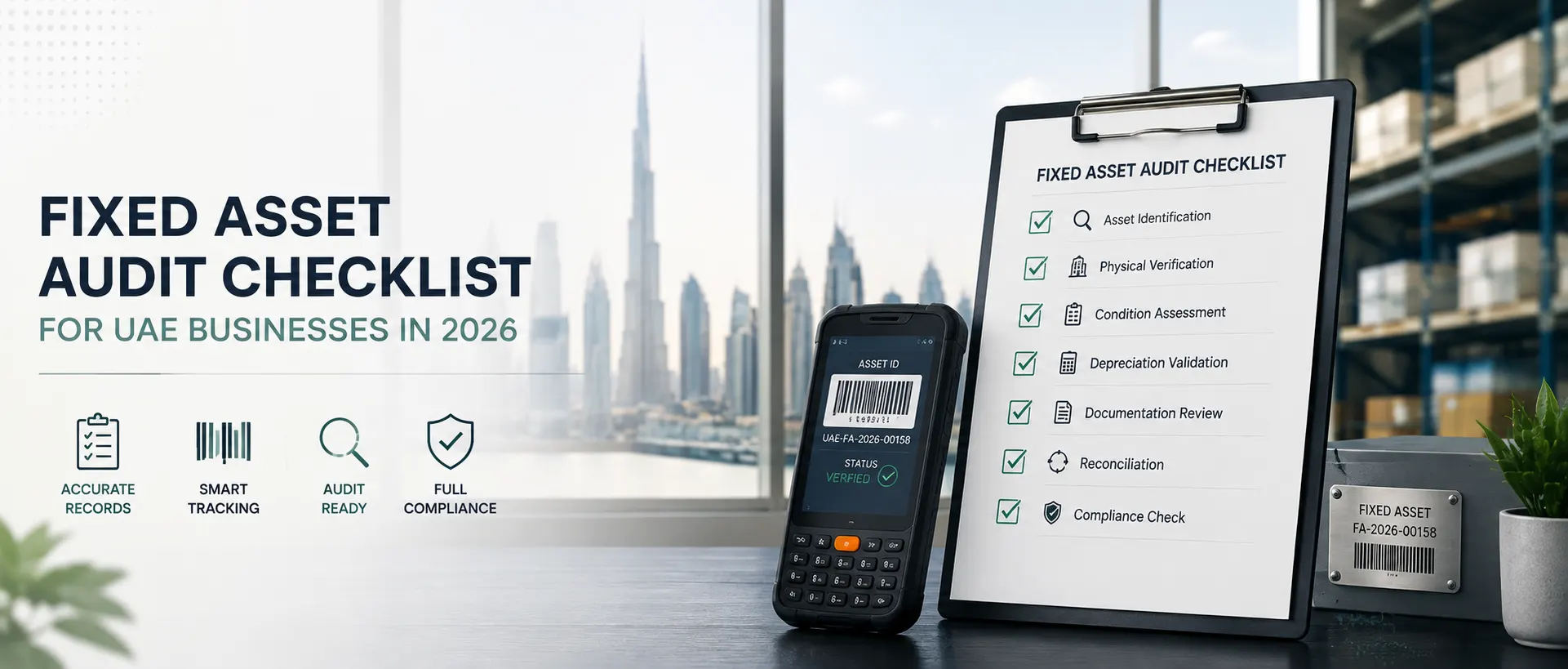
A fixed asset audit checklist confirms that every asset on the books actually exists and is correctly valued. It covers physical verification, register reconciliation, and depreciation testing under IFRS. UAE businesses need this beyond routine bookkeeping. Corporate tax depreciation deductions depend directly on an accurate fixed asset register.
Overview of the Checklist
A fixed asset audit checklist for UAE businesses covers seven areas, moving from documentation through physical checks to tax alignment.
- Register completeness. The fixed asset register is current and matches the general ledger balance.
- Physical tagging. Every asset carries a readable tag matching its register entry.
- Location accuracy. Recorded location matches where the asset actually sits at the time of count.
- Depreciation method. The method and useful life applied are consistent and recalculated for a sample.
- Disposals and additions. Everything disposed of is removed, and everything added is recorded within the period.
- Supporting documentation. Purchase invoices, warranty records, and insurance details are on hand.
- Corporate tax alignment. Depreciation in the accounts matches what was claimed on the tax return.
What Is a Fixed Asset Audit?
A fixed asset audit is a structured review confirming that recorded assets exist and are valued correctly. It checks four things together: existence, ownership, valuation, and the depreciation applied to each asset over its useful life.
This differs from a general financial audit in one key way. A financial audit samples transactions across the whole business. A fixed asset audit examines a specific register in detail, asset by asset. Each item carries its own cost, useful life, and depreciation schedule that needs individual verification.
Fixed Asset Audit Procedure: Step by Step
A fixed asset audit procedure generally follows five stages, each building on the last:
- Scope the register: Confirm which assets fall under the audit, then pull the current register alongside prior-year figures.
- Verify existence physically: Walk the floor or warehouse and match tagged assets against the register, not the reverse.
- Reconcile the register to the ledger: Confirm individual asset values sum to the general ledger balance for property, plant, and equipment.
- Test valuation and depreciation: Recalculate depreciation for a sample of assets and compare it against the books.
- Review documentation: Check purchase invoices, disposal records, and any revaluation support for assets tested.
The Fixed Asset Audit Checklist for UAE Businesses
An asset audit checklist UAE businesses can work through covers documentation, physical checks, and compliance together.
| Checklist Item | What to Verify |
| Fixed asset register | Complete, current, and matched against the general ledger balance |
| Physical tags | Every asset carries a readable tag matching its register entry |
| Location records | Recorded location matches actual physical location at time of count |
| Depreciation schedule | Method and useful life applied consistently, recalculated for a sample |
| Disposals and additions | All disposals removed and all additions recorded within the audit period |
| Supporting documents | Purchase invoices, warranty records, and insurance details available on request |
| Corporate tax alignment | Depreciation in the accounts matches what was claimed for tax purposes |
Physical Verification: The Step Most Checklists Skip
Physical verification means someone actually locates and confirms every asset. It does not mean assuming the paper record is correct by default.
An asset management system built around ISO 55001 treats this kind of verification as a routine control. ISO 55001 is the international standard for asset management systems. Businesses that only verify assets once a year tend to find far more discrepancies than those checking continuously throughout the year.
RFID and barcode tagging change how much this step actually costs a business. DCS’s RFID approach to SOX compliance shows how automatic tag reads can replace manual counts. That creates a continuous, timestamped movement history instead of one annual walk through the site.
Reconciling the Fixed Asset Register
Reconciling the register means confirming that individual asset values sum correctly across every entry. The total should match the general ledger balance for property, plant, and equipment.
A mismatch here usually points to one of three things. It could be a missed disposal, an unrecorded addition, or a posting error somewhere in the year. IAS 16 sets the underlying accounting rules for recognizing, measuring, and depreciating property, plant, and equipment. Most UAE businesses apply it directly through their annual financial statements.
An audit of fixed assets under IAS 16 checks two things closely. It confirms an asset was capitalized correctly at cost. It also confirms depreciation reflects a reasonable useful life rather than a habit carried forward.
DCS’s Enterprise Asset Management platform generates depreciation reports directly from the tagged asset register. Reconciliation then starts from data that already matches physical reality on the ground.
Need help getting your fixed asset register audit-ready? Talk to DCS.
UAE Corporate Tax and Depreciation: What Auditors Check
UAE corporate tax law does not prescribe its own depreciation rates. The Federal Tax Authority’s guidance confirms that taxable income is calculated from the net profit shown in the financial statements. Those statements must be prepared under the applicable accounting standards.
In practice, accounting depreciation and tax depreciation are the same figure in most cases. That link makes register accuracy a tax matter, not only an accounting one.
An auditor checking corporate tax alignment confirms one specific thing. Depreciation claimed on the tax return has to match what was recorded under IFRS. Any gap between the two invites a Federal Tax Authority query during a corporate tax review.
Financial records, including the fixed asset register, must be retained for seven years under UAE tax procedures law. A register that only exists as an annual export from accounting software makes producing seven consistent years far harder than it needs to be.
Common Fixed Asset Audit Findings and How to Prevent Them
Certain findings show up again and again once a fixed asset audit actually gets underway. Knowing them in advance makes each one easier to prevent before the auditor flags it.
- Ghost assets on the register. Equipment disposed of or scrapped without a corresponding removal from the books. Prevent this with a disposal process tied directly to the register.
- Untagged or mislabeled assets. A physical count that cannot match an item to its register entry. Prevent this with consistent tagging at the point of acquisition.
- Depreciation inconsistency. Different useful lives applied to similar assets across departments. Prevent this with one documented depreciation policy applied uniformly.
- Location mismatches. An asset recorded at one site but physically located at another. Prevent this by capturing location updates at the point of movement.
How DCS Supports Fixed Asset Audit Checklist Readiness
DCS builds fixed asset audit readiness into daily operations, not a once-a-year project. Its best fixed asset tracking software for GCC businesses combines barcode or RFID identification with a live register.
Physical verification and reconciliation then draw from the same continuously updated source. For businesses already running barcode-based inventory, DCS’s barcode inventory approach extends naturally into fixed asset tagging without a separate rollout.
Larger operations benefit from DCS’s IoT asset tracking approach, which keeps location and status current across multiple sites. A UAE distribution business working with DCS replaced its annual spreadsheet count with continuous RFID tracking. That change cut the time its finance team spent reconciling the register before the year-end audit.
FAQs on Fixed Asset Audit Checklist
How often should a fixed asset audit be conducted?
Most UAE businesses run a full physical verification annually, alongside the statutory audit. Continuous tracking through barcode or RFID tagging reduces the effort each count requires, and it catches discrepancies well before audit season starts.
What is the difference between a fixed asset audit and inventory count?
An inventory count covers stock intended for sale. A fixed asset audit covers equipment, furniture, and property the business uses internally over multiple years, with different depreciation rules attached to each category.
Does UAE corporate tax require a separate fixed asset register from the accounting one?
No. UAE corporate tax generally follows the depreciation already recorded under IFRS. Businesses use one register for both purposes, rather than maintaining separate accounting and tax versions of the same data.
What documents does an auditor usually request for a fixed asset audit?
Auditors typically request the fixed asset register, purchase invoices, disposal records, and depreciation schedules. Insurance or warranty documentation tied to significant assets speeds up the review considerably.
Can RFID or barcode tagging replace a manual fixed asset audit entirely?
Tagging does not eliminate the need for an audit, but it removes most of the manual counting work involved. Valuation, depreciation, and documentation still require professional review, regardless of how the physical count was performed.
