

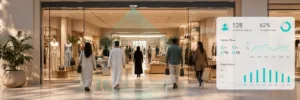
Retail success is not measured by sales alone. Understanding how many customers enter your store, when they visit, and how many make a purchase is equally important for improving performance.
وفقًا لـ RetailNext, retailers that use in-store analytics can make better decisions around staffing, store layouts, and customer experience by understanding visitor behavior beyond transaction data. A people counting system provides this visibility by measuring footfall in real time and turning visitor traffic into actionable business insights. Whether you operate a single retail outlet or a multi-store chain across the UAE, accurate footfall data helps improve conversion rates, optimize staffing, and evaluate marketing performance.
DCSME helps retailers deploy intelligent people counting solutions that integrate with existing retail systems to support data-driven decision-making.
أهم النقاط
- People counting system UAE deployments range from simple infrared door counters to AI-powered 2D and 3D stereo vision sensors that distinguish people from objects.
- People counter for retail stores data is most valuable when paired with sales figures, since footfall alone does not show conversion rate without that comparison.
- Retail people counting in the UAE has scaled well beyond single stores, with enterprise rollouts across 30 or more locations using networked counting devices.
- Customer counting system technology now commonly protects visitor privacy by masking identifiable data at the source, supporting compliance with data protection expectations.
- People counting technology integrates with staffing, marketing, and store layout decisions, turning a simple visitor count into a broader retail analytics tool.
What Is a People Counting System?
A people counting system is a retail analytics solution that measures the number of visitors entering and leaving a store. Using sensors, AI-powered cameras, or 3D vision technology, it automatically records footfall and displays visitor data through dashboards and reporting platforms.
Unlike manual counting, modern people counting systems provide continuous, real-time insights that help retailers understand customer traffic patterns, calculate conversion rates, and improve operational planning.
Why Footfall Data Matters More Than Sales Data
Sales reports tell you how much revenue your store generated, but they do not explain how customers interacted with your store before making a purchase or leaving without buying anything.
Footfall data fills this gap by helping retailers answer important business questions, such as:
- How many visitors entered the store today?
- What percentage of visitors completed a purchase?
- Which hours generate the highest customer traffic?
- Did a marketing campaign increase store visits?
- Is staffing aligned with peak shopping hours?
When combined with POS data, footfall analytics provides a clearer picture of store performance and customer behavior.
How Does a People Counting System Work?
A people counting system automatically records visitor traffic without requiring manual observation. Most systems are installed above entrances, where they detect and count customers as they enter or leave the store.
The process typically includes:
- Sensors or AI-enabled cameras monitor store entrances.
- The system detects visitors while filtering out non-human objects such as shopping carts or strollers.
- Visitor counts are processed in real time.
- Data is transferred to a cloud or on-premises dashboard.
- Reports help managers analyze hourly, daily, weekly, or monthly traffic trends.
Types of People Counting Systems
Different retail environments require different counting technologies. The right solution depends on store size, visitor traffic, entrance design, and reporting requirements.
| التكنولوجيا | الأفضل لـ | Key Advantage |
| Infrared Counters | Small stores | Cost-effective visitor counting |
| 2D Video Counters | Medium retail outlets | Improved counting accuracy |
| 3D Stereo Vision Counters | Shopping malls and busy entrances | High accuracy in crowded environments |
| AI-Based People Counters | Enterprise retail chains | Advanced analytics and behavioral insights |
How Retailers Use Footfall Data
A people counting system does more than record visitor numbers. When combined with sales and operational data, it helps retailers understand customer behaviour, measure store performance, and make better business decisions.
Here are some of the most common applications:
Conversion Rate Analysis
Compare the number of store visitors with completed transactions to understand how effectively your store converts footfall into sales. This helps identify opportunities to improve merchandising, customer service, or promotional strategies.
Staff Planning
Use hourly and daily footfall trends to schedule employees during peak shopping periods. Better workforce planning improves customer service while reducing unnecessary labour costs during quieter hours.
Marketing Performance
Evaluate whether promotional campaigns, seasonal events, or in-store offers are increasing customer visits. Comparing footfall before and after a campaign provides a clearer picture of its effectiveness.
Store Layout Optimization
Identify high-traffic and low-traffic areas within the store to optimize product placement, promotional displays, and customer flow.
Multi-Store Performance
Retail chains can compare visitor trends across different locations to benchmark performance, allocate resources, and identify stores that require operational improvements.
Common Mistakes to Avoid When Choosing a People Counting System
Not all people counting solutions deliver the same level of accuracy or analytics. Considering the following factors before implementation can help retailers avoid costly mistakes.
- Focusing only on hardware costs instead of long-term accuracy and reporting capabilities.
- Ignoring integration requirements with existing POS, ERP, or retail analytics platforms.
- Selecting technology that cannot scale as additional stores or locations are added.
- Overlooking privacy features, especially AI-based systems that should anonymize visitor data.
- Using footfall data in isolation instead of analyzing it alongside sales and operational metrics.
Choosing the right solution is not just about counting visitors. It is about turning visitor data into meaningful business insights.
How to Choose the Right People Counting System
Every retail environment has different operational requirements. Selecting the right technology depends on your store layout, visitor traffic, and reporting objectives.
Before investing in a people counting solution, consider the following:
- Store format: Shopping malls, supermarkets, fashion outlets, and specialty stores often require different counting technologies.
- Visitor volume: High-footfall entrances generally benefit from AI-powered or 3D stereo vision systems for greater accuracy.
- Reporting requirements: Determine whether you need basic visitor counts or advanced retail analytics dashboards.
- System integration: Ensure the solution works with existing POS, ERP, workforce management, or business intelligence platforms.
- Future expansion: Choose a scalable solution that can support additional stores without changing reporting standards.
- Vendor expertise: Work with an implementation partner that understands retail operations and provides deployment, integration, and ongoing technical support.
لماذا التكامل مهم
Footfall data becomes significantly more valuable when connected with the systems retailers already use to manage daily operations.
A modern people counting solution can integrate with:
- Point of Sale (POS) systems
- Retail ERP platforms
- Business Intelligence (BI) dashboards
- Workforce management software
- Customer experience and analytics platforms
By combining visitor data with sales, staffing, and operational metrics, retailers gain a complete view of store performance. This enables faster decision-making, more accurate forecasting, and continuous improvement across multiple locations.
Why Choose DCSME for People Counting Solutions
Implementing a people counting system requires more than installing sensors above a store entrance. The accuracy of visitor data depends on selecting the right technology, positioning sensors correctly, and integrating the solution with existing retail systems.
DCS supports retailers across the UAE with:
- AI-powered people counting solutions for different retail environments.
- Integration with POS, ERP, and retail analytics platforms.
- Solutions that support both single-store deployments and multi-location retail networks.
- End-to-end services, including site assessment, installation, system configuration, and technical support.
الخلاصة
Understanding customer traffic is just as important as measuring sales. While transaction data explains what customers purchased, footfall analytics reveals how shoppers interact with your store before they reach the checkout. By combining visitor insights with sales and operational data, retailers can improve staffing decisions, optimize store layouts, measure campaign performance, and identify opportunities to increase conversions.
As retail becomes increasingly data-driven, investing in the right people counting solution helps build smarter stores and supports long-term business growth.
FAQs on Retail People Counting System
What is a people counting system?
A people counting system is a retail analytics solution that automatically measures the number of visitors entering and leaving a store. It helps retailers analyze customer traffic, calculate conversion rates, and improve operational planning.
How accurate are AI-based people counting systems?
Modern AI-powered and 3D stereo vision systems can achieve very high counting accuracy, even in busy retail environments. Their performance depends on factors such as sensor placement, entrance design, and installation quality.
Can people counting systems integrate with POS software?
Yes. Many solutions integrate with POS systems, allowing retailers to compare visitor numbers with completed sales and calculate store conversion rates automatically.
Do people counting systems collect personal information?
Most modern systems are designed with privacy in mind. AI-powered solutions typically anonymize visitor data and focus on counting people rather than identifying individuals, helping businesses meet privacy and data protection requirements.
Which businesses benefit most from people counting systems?
People counting systems are widely used in retail stores, shopping malls, supermarkets, pharmacies, airports, museums, banks, public buildings, and other locations where understanding visitor traffic helps improve operations and customer experience.
