

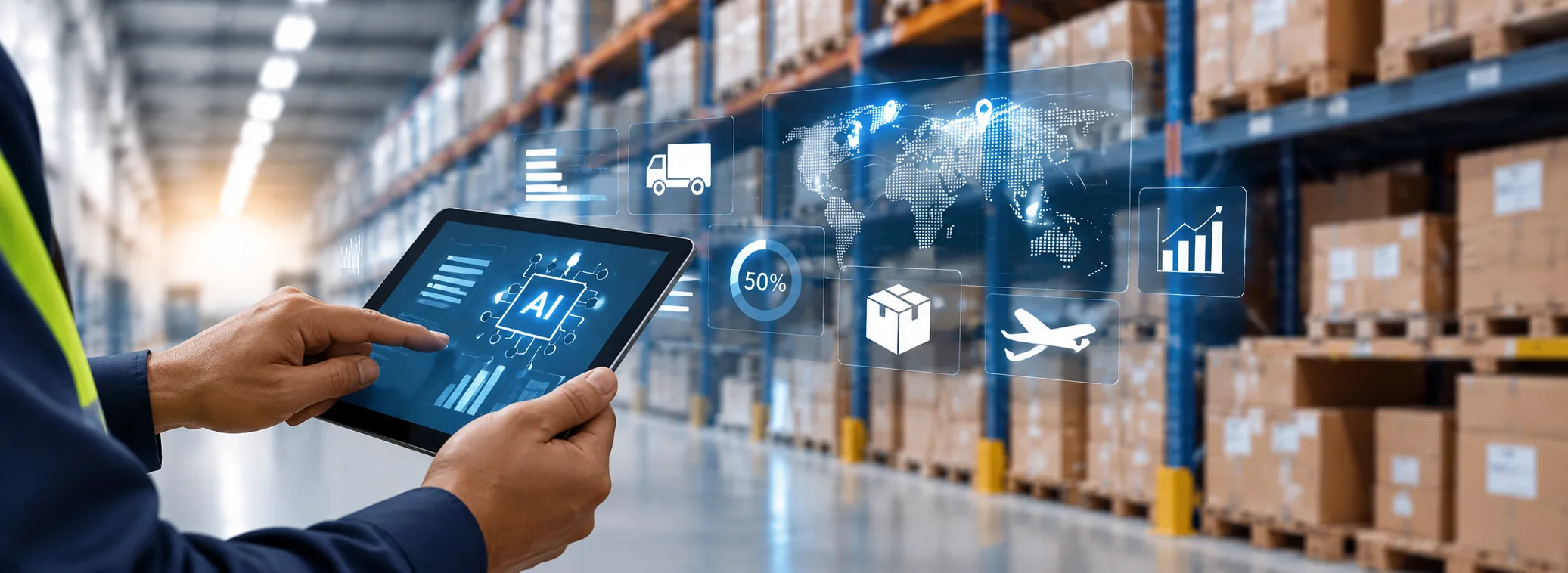
AI inventory management applies machine learning to sales, stock, and supply chain data to forecast demand, trigger replenishment automatically, and flag discrepancies before they become expensive. It works by analyzing patterns a human planner would miss, but only when it has reliable data flowing in from connected systems like RFID, barcode, and point-of-sale platforms. Retailers lose an estimated $1.77 trillion a year globally to inventory distortion, which is exactly the gap AI is being deployed to close.
أهم النقاط
- AI inventory management forecasts demand and automates replenishment, but it depends entirely on the data quality of the systems feeding it.
- McKinsey research shows AI-driven forecasting can cut supply chain errors by 20 to 50 percent, and reduce lost sales from stockouts by up to 65 percent.
- Top-performing supply chain organizations use AI for demand forecasting at more than double the rate of lower performers, according to Gartner.
- Computer vision and anomaly detection are extending AI beyond forecasting into physical shelf monitoring and theft or error detection.
- Inventory distortion costs retailers an estimated $1.77 trillion annually worldwide, split between out-of-stocks and overstocks.
What Is AI Inventory Management?
AI inventory management uses machine learning and predictive analytics to forecast demand, optimize stock levels, and automate reordering across a retail operation. Instead of a planner reviewing spreadsheets and adjusting orders by intuition, an AI model processes sales history, seasonality, and live signals to recommend or trigger decisions.
The key distinction is what the AI model actually looks at. A model trained on clean, frequent data from connected registers, RFID readers, or barcode scans produces genuinely useful forecasts. A model fed weekly spreadsheet exports from three disconnected systems produces something closer to an educated guess, no matter how sophisticated the algorithm underneath it claims to be. DCS’s نظام إدارة المستودعات is built to close that gap between what a model needs and what most retailers actually feed it.
AI in Inventory Management: The Data Layer That Makes It Work
AI in inventory management works only as well as the data pipeline underneath it, and most vendor pitches skip that part entirely. Machine learning models need consistent, timely inputs, not a single annual data dump or a manual count from three weeks ago.
That pipeline usually runs through three stages: connectivity, integration, and analysis. Sensors and scanners capture stock movement as it happens; that data feeds into a central system alongside sales and supplier records, and only then does an AI model have something worth analyzing.
DCS’s RFID retail solutions build that first stage, since a forecasting model is only as accurate as the stock counts it’s trained on.
AI Inventory Optimization: Demand Forecasting and Automated Replenishment
AI inventory optimization analyzes historical sales, seasonal patterns, and external signals to predict demand more precisely than manual forecasting ever could, then triggers restocks automatically once inventory crosses a set threshold.
McKinsey research shows AI-driven forecasting can reduce supply chain errors by 20 to 50 percent compared with traditional methods, which translates into a drop in lost sales from stockouts of up to 65 percent.
The same McKinsey research found warehousing costs can fall by 5 to 10 percent once forecasting improves, since businesses stop holding excess safety stock to cover uncertainty their model used to guess at rather than predict. Automated replenishment takes this a step further by removing the manual reorder decision entirely, triggering a purchase order the moment a threshold is crossed rather than waiting for a planner to notice.
Machine Learning Inventory Management: Anomaly Detection and Computer Vision
Machine learning inventory management extends well beyond forecasting into catching problems a human reviewer would likely miss until it’s too late. Anomaly detection models scan sales and stock data continuously, flagging patterns that suggest theft, a data entry error, or a sudden shift in demand nobody has noticed yet.
Computer vision adds a physical layer on top of this. Cameras trained to recognize empty shelf space or misplaced products can alert staff before a customer even notices the gap, turning what used to be a manual walk-the-floor task into something closer to continuous monitoring. DCS’s autonomous machine vision systems apply this same self-learning approach to physical inspection, improving accuracy the longer they run rather than staying static like a fixed rule set.
Top-performing supply chain organizations use AI and machine learning for demand forecasting at more than twice the rate of lower performers, according to Gartner, and that gap tends to widen as the underlying technology matures.
AI Inventory Management in Retail: Where It’s Actually Being Used
AI inventory management in retail shows up most concretely in three places: forecasting for seasonal demand spikes, automated reordering across multi-location chains, and shelf-level accuracy checks that used to require a full physical count. A grocery chain adjusting stock ahead of a holiday, a fashion retailer managing size and color variants across dozens of stores, and a pharmacy tracking expiration-sensitive stock all lean on the same underlying models, tuned to very different data.
None of this replaces the identification layer retailers already depend on. Retail inventory distortion, the combined cost of stockouts and overstocks, is projected at $1.77 trillion globally, split between roughly $1.2 trillion in lost sales and over $500 billion in excess stock and markdowns.
What to Check Before Choosing an Approach
Before evaluating any AI inventory management vendor, a retailer needs to confirm a few basics are already in place, since skipping this step is where most implementations quietly fail. DCS’s تتبع الأصول إنترنت الأشياء approach covers the same groundwork for operations that extend beyond a single store.
- Data connectivity. Sales, stock, and supplier data need to flow into one system, not sit in three disconnected exports.
- Identification infrastructure. RFID or barcode scanning must capture stock movement accurately before a model can learn from it.
- A defined decision to automate. The clearest wins target one specific process, like reorder triggers, rather than a vague goal of “smarter inventory.”
- A named owner for exceptions. Someone has to review what the model flags, or anomalies pile up unresolved.
How DCS Builds the Foundation for AI Inventory Management
DCS focuses on the layer beneath the AI model rather than selling a forecasting algorithm on its own, since that data foundation is what determines whether any AI investment actually pays off. Its حلول تكنولوجيا التجزئة combine RFID and barcode-based inventory automation with real-time visibility across stores, so the data an AI model would eventually need is already flowing cleanly.
For retailers running RFID at scale, DCS’s approach to reducing inventory errors replaces batch updates that lag behind real activity with continuous data capture instead. A GCC retailer working with DCS moved from manual weekly stock counts to RFID-based real-time tracking, giving its team the clean data foundation needed before adding predictive forecasting.
Want to know if your data foundation is ready for AI inventory management? Talk to DCS.
Common Mistakes to Avoid When Adopting AI
- Buying forecasting software before fixing data quality. A sophisticated model fed bad inputs produces confident, wrong answers.
- Expecting one model to work across every product category. Fashion, grocery, and electronics have different demand patterns and need separate tuning.
- No process for reviewing what the AI flags. Alerts that nobody acts on provide no more value than no alert at all.
- Treating AI as a one-time project. The models that improve over time are the ones retailers keep feeding with fresh data.
أسئلة متكررة
Does AI inventory management replace the need for barcode or RFID scanning?
No, it depends on it. AI models need accurate, timely stock data to forecast anything useful, and barcode or RFID scanning is usually what generates that data in the first place.
How much does AI inventory management typically cost to implement?
Costs vary widely depending on how much data infrastructure already exists. A retailer with clean, connected systems can add forecasting relatively quickly, while one starting from spreadsheets needs to build that foundation first, which often costs more than the AI layer itself.
Can small retailers use AI inventory management, or is it only for large chains?
Small retailers can use it too, particularly cloud-based tools that plug into existing POS systems without heavy customization. The bigger barrier is usually data quality, not company size.
What is the difference between AI inventory optimization and traditional inventory forecasting?
Traditional forecasting relies on historical averages and periodic manual adjustments. AI inventory optimization continuously updates its predictions as new data arrives, adapting to real-time shifts rather than waiting for the next planning cycle.
How long does it take to see results from AI inventory management?
Retailers with existing connected data can see forecasting improvements within a few months. Those needing to build out RFID or barcode infrastructure first should expect that groundwork to take longer than the AI implementation itself.
Talk to DCS About Getting Your Data Ready
AI inventory management delivers real results, but only once the data feeding it is accurate and current. اتصل بـ DCS to see what your retail operation needs in place before an AI forecasting layer can actually deliver on its promise.
