

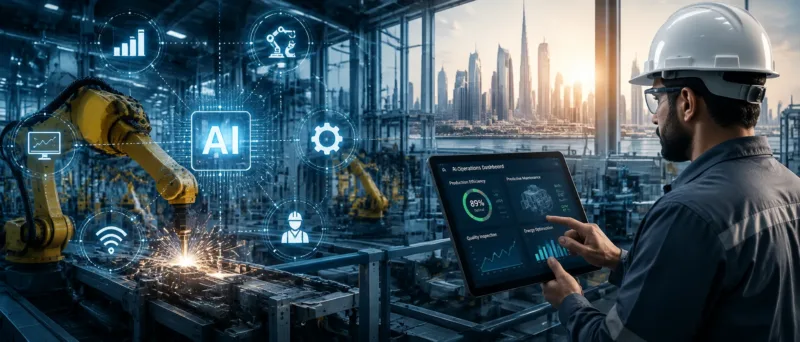
Industrial AI in the Middle East puts machine learning on real plant data. It catches failing equipment, flags quality defects, and monitors remote assets. The catch? It only works when sensors and systems underneath it actually talk to each other.
The AI model itself is the easy part of the whole project. Getting machine data out of twenty-year-old equipment and into a usable format?
DCS’s المصنع الذكي team starts at that layer, not the model layer. Sensors go on the equipment first. Networking gets built between them. Systems get connected to each other. Then the AI layer has something real to work with.
This guide walks through where AI delivers real results in the region. Predictive maintenance, quality inspection, and field operations. Plus the common mistakes that break projects before they produce anything useful.
What Is Industrial AI in the Middle East?
Industrial AI in the Middle East means machine learning applied to factory and field data. Think vibration readings from a compressor in an oil refinery. Temperature logs from cold storage equipment at a food plant. Camera feeds scanning products on a packaging line.
It is not chatbot AI or document summarization or anything text-based. It works with physical sensors mounted on physical equipment. A model watches that data constantly for patterns a shift supervisor would miss over time.
One important point worth mentioning about model portability. A model trained at one plant does not automatically transfer to another site. Different machines produce different sensor signals and different failure patterns. Every site needs its own validation pass before the model goes live.
AI in Industrial Operations: Three Layers That Have to Work
AI in industrial operations fails at the bottom layer, not the top. Three layers have to hold up before any model adds real value.
- Connectivity. Machines transmit data through IoT sensors to a central platform. Old equipment gets retrofitted with sensors bolted on externally to capture readings.
- Integration. Machine data meets ERP and MES data in one place. A sensor reading without production context is just a meaningless number.
- Analysis. AI models process that combined data and surface a prediction. Then they route it to a real person who can act on it.
Skip layer one or two and the AI layer has nothing useful underneath it. DCS’s real-time manufacturing analytics work treats connectivity as the actual job, not the preamble to it.
Predictive Maintenance AI: Where the ROI Is Clearest
Predictive maintenance AI watches sensor data for early signs of failure. Vibration spikes on a bearing. Temperature drift on a motor winding. Pressure drops across a compressor stage. It flags the problem before the machine actually breaks down.
Why does this use case lead every industrial AI list? Because the math is obvious to anyone running a plant. Unplanned downtime costs real money per hour of lost production. Scheduled maintenance costs a fraction of that same amount.
A digital twin takes it one step further than sensor monitoring alone. It models the entire asset, not just the sensor feed coming off it. Your team can simulate a repair decision before committing to the downtime. GE does this for every aircraft engine it builds and services worldwide.
AI Manufacturing Solutions for Quality Inspection
AI manufacturing solutions for quality use cameras instead of human eyes. A trained model catches scratches, cracks, or missing parts at full line speed. Every single unit gets checked on the line. Not one in twenty at random.
Manual inspection has two problems that cameras do not share. It is slow and it drifts as the inspector gets tired. An inspector at hour ten of a shift misses what a camera catches every single time.
DCS’s autonomous machine vision systems use self-learning algorithms that improve over time. They get more accurate as production data accumulates through each shift. Lighting and camera settings adjust automatically across different products on the line.
AI for Field Operations: The Assets You Cannot Walk To
AI for field operations solves a different problem than factory AI. The asset sits far away. An oil rig. A utility meter across town. An aircraft in a hangar.
These assets are expensive or slow to physically reach. So remote data collection matters more here than anywhere else.
DCS’s Meter Reading and Field Activity Management solution gives utility providers live visibility into field activity. That same connected data becomes the foundation for AI anomaly detection later.
In regulated maintenance, DCS’s Honeywell voice-guided maintenance captures technician data by voice. An inspection that used to live on paper becomes a dataset AI can actually process.
Industrial AI in the Middle East: Government Backing
Industrial AI in the Middle East is not just a vendor pitch. Governments are funding and mandating the shift.
The UAE’s Operation 300bn targets raising industrial GDP from AED 133 billion to AED 300 billion by 2031. Advanced technology and Fourth Industrial Revolution adoption are named priorities. Not vague goals. Named priorities with budget behind them.
Saudi Arabia runs a parallel push. The NIDLP under Vision 2030 positions the Kingdom as an industrial hub with Industry 4.0 as a specific focus area.
This shows up in production results, not just policy documents. The WEF Global Lighthouse Network includes active sites in Saudi Arabia, UAE, and Qatar. Lighthouse status means demonstrated gains at production scale.
Picking AI Manufacturing Solutions: Check These First
Before you evaluate any AI manufacturing solutions vendor, make sure the basics exist.
- Sensor coverage. AI needs consistent data from the equipment it monitors. A partial retrofit leaves blind spots.
- System integration. Machine data has to reach your ERP and MES. Isolated dashboards help nobody.
- One clear decision. The best AI projects target one specific question. When to maintain. What to reject. Where to reroute.
- Local validation. A model proven at one site is a starting point. Not a finished product for the next one.
- A named owner. Someone has to act on what the AI flags. Otherwise alerts pile up unread.
How DCS Builds Industrial AI in the Middle East
DCS builds industrial AI in the Middle East from the bottom up. Sensors first. Networking second. Integration third. AI model last.
The same Enterprise Asset Management platform that tracks equipment location and condition feeds predictive maintenance models directly. AI is not a separate tool stapled onto the side.
For oil and gas and energy clients, DCS connects pumps, compressors, and turbines with Industrial IoT. Sensor thresholds catch failures early. No full facility rebuild required.
A GCC manufacturer working with DCS moved from reactive repairs to sensor-triggered maintenance. Unplanned downtime dropped on equipment that nobody had been actively monitoring before.
Want to see where AI fits your operation? Contact the DCS team.
Mistakes That Kill Industrial AI Projects
- Buying the model before the data pipeline exists. A great algorithm with bad data is just expensive noise.
- Assuming one model works everywhere. Different sites have different equipment, sensors, and failure patterns. Validate locally.
- No owner for alerts. AI flags a problem. Nobody acts. The project dies quietly.
- Treating AI as a project, not infrastructure. Real value builds as more sites and use cases connect to the same data layer.
FAQs on Industrial AI in the Middle East
Does industrial AI mean replacing existing equipment?
No. Most sites retrofit sensors onto existing machines. Equipment that is ten or twenty years old can still be connected. You do not need a new plant to run AI.
How fast does predictive maintenance AI show results?
A site with connected equipment can see results within months. A site starting from paper logs needs the connectivity layer built first. That takes longer than the model itself.
Can AI manufacturing solutions run across plants with different systems?
Yes, but each plant needs local validation. Different equipment and failure patterns mean a model from site A is evidence, not a guarantee, at site B.
How is AI in industrial operations different from business AI?
Industrial AI works with physical sensor and machine data. Business AI works with text, transactions, and documents. The data pipeline and safety stakes are completely different.
Is AI for field operations the same as factory AI?
Not really. Field assets sit far from the team that maintains them. Remote data capture and anomaly detection matter more than production line throughput.
