

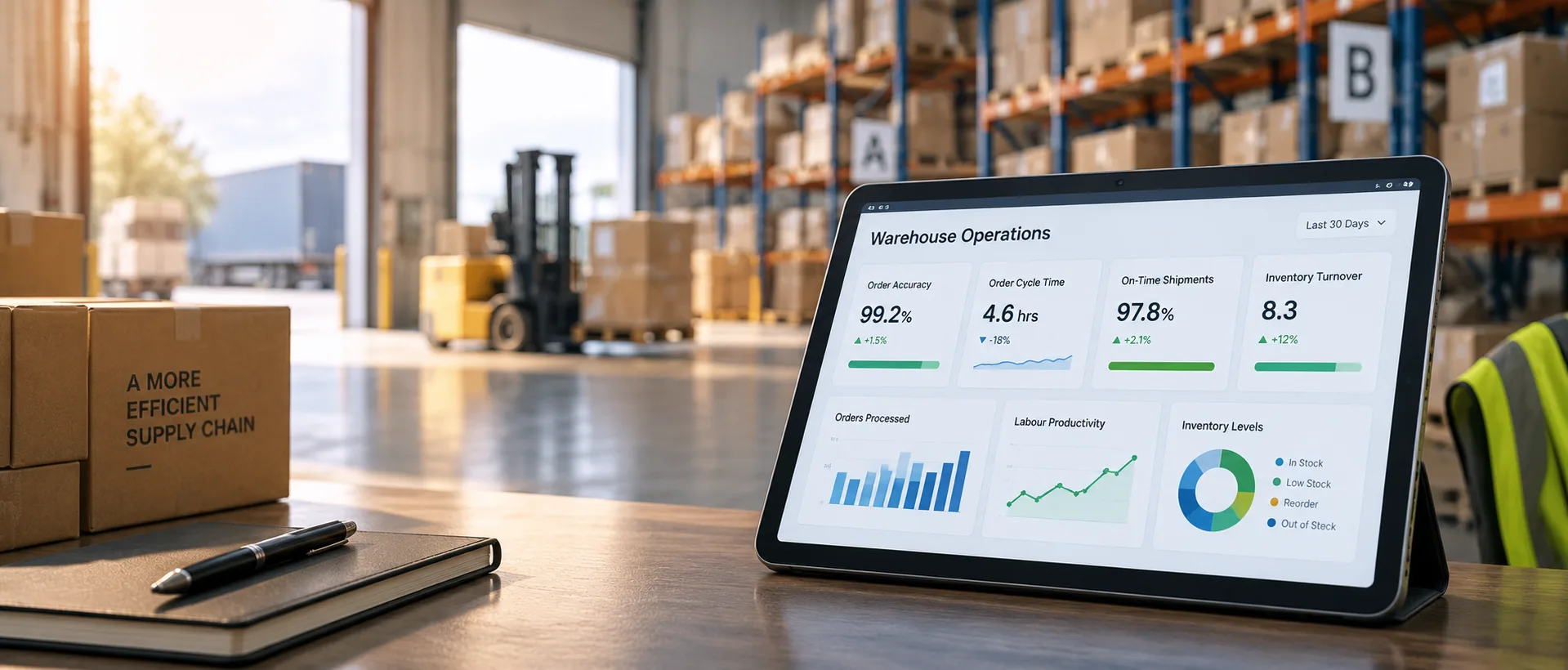
Warehouse performance is not always easy to measure by simply looking at daily operations. A warehouse may appear busy while picking accuracy drops, orders take longer to process, or inventory is not stored efficiently. Warehouse KPIs help operations managers turn these activities into clear, measurable data.
In this guide, we explain the most important warehouse KPIs, why they matter, how often to review them, and how technology such as WMS, barcode, and تحديد الهوية بموجات الراديو can make KPI tracking more accurate and reliable.
أهم النقاط
- Focus on 8 to 12 important KPIs instead of tracking every available warehouse metric.
- Review operational KPIs such as picking accuracy and order fulfilment daily.
- Track strategic KPIs such as inventory turnover and cost per order over longer periods.
- Use barcode, RFID, and a نظام إدارة المستودعات to capture accurate data automatically.
- Choose KPIs based on your warehouse type, customer requirements, and operational goals.
Why Are Warehouse KPIs Important?
Modern warehouses need to process orders faster while maintaining accuracy and controlling costs. Small problems can quickly become expensive when they affect hundreds or thousands of orders.
Warehouse KPIs show where these problems are happening. They help managers identify delays, improve workforce productivity, reduce errors, and make better operational decisions based on actual data.
Which Warehouse KPIs Should You Track?
Different warehouse activities require different KPIs. The following metrics cover the main areas that operations managers should monitor.
Inventory KPIs
| KPI | What It Measures | Why It Matters |
| Inventory Accuracy | Difference between recorded and actual inventory | Helps prevent stockouts, overstocking, and fulfillment errors |
| Inventory Turnover | How quickly inventory moves through the warehouse | Helps reduce excess stock and tied-up capital |
| Shrinkage Rate | Inventory lost through damage, theft, or errors | Highlights inventory losses and control issues |
Receiving and Putaway KPIs
- Receiving Cycle Time: Measures how long it takes to process incoming goods.
- Dock to Stock Time: Measures the time from receiving goods to making them available for picking.
- Putaway Accuracy: Measures how often products are stored in the correct location.
These KPIs help identify delays and errors early in the warehouse process.
Picking and Order Fulfilment KPIs
- Picking Accuracy: Measures the percentage of orders picked correctly.
- Order Cycle Time: Measures the time from receiving an order to shipping it.
- Lines Picked per Labour Hour: Shows how efficiently warehouse employees complete picking tasks.
- Perfect Order Rate: Measures orders that are delivered complete, accurate, undamaged, and on time.
These metrics directly affect fulfilment speed, operating costs, and customer satisfaction.
Labor and Cost KPIs
- Labour Cost per Item: Shows how much labour is required to process each item.
- Cost per Order: Measures the total cost of fulfilling an order.
- On-Time Shipment Rate: Shows the percentage of orders shipped by the promised date.
Tracking these metrics helps managers identify where labour and operating costs can be reduced.
Safety KPIs
Safety should also be part of warehouse performance measurement. Track metrics such as safety incidents, lost time incidents, and days since the last incident to identify risks and improve workplace safety.
How Often Should Warehouse KPIs Be Reviewed?
Not every KPI needs daily review. The right review frequency depends on how quickly the metric can change and how directly it affects daily operations.
| التردد | KPIs to Review | الغرض |
| Daily | Picking accuracy, order cycle time, on-time shipment rate | Identify and fix immediate operational issues |
| Weekly | Receiving time, labour productivity, cost trends | Identify performance patterns |
| Monthly | Inventory turnover, cost per order, overall productivity | Review long-term performance and business trends |
How Can You Make Warehouse KPI Tracking More Reliable?
Accurate KPIs depend on accurate data. Manual data entry can create errors, delays, and inconsistent reports. The following practices can make warehouse KPI tracking more reliable:
- Automate data capture: Use barcode and RFID scanning to automatically record inventory movement and warehouse activities.
- Connect warehouse systems: Integrate your WMS with ERP and other business systems to keep operational data consistent.
- Track data in real time: Give managers live visibility into inventory, picking, receiving, and shipping performance.
- Use standardised KPIs: Define clear formulas and measurement methods so teams track the same metrics consistently.
- Review data regularly: Check KPI trends and investigate unusual changes before they become larger operational problems.
A نظام إدارة المستودعات can bring these processes together by capturing warehouse activity at the point of work and converting it into reliable performance data.
How DCSME Helps Improve Warehouse Performance
The right KPIs are only useful when businesses have the technology and data infrastructure to track them accurately. DCSME helps warehouse and distribution operations improve KPI visibility through connected data capture and warehouse systems.
Key areas where DCSME can support warehouse operations include:
- Barcode and RFID integration: Automate inventory and activity tracking across warehouse processes.
- WMS integration: Connect warehouse operations with ERP and other business systems.
- Real-time data capture: Improve visibility into inventory, picking, receiving, and shipping activities.
- KPI and performance reporting: Help teams monitor the metrics that matter most to their specific operation.
- Warehouse process optimisation: Identify operational gaps and recommend technology solutions that support measurable improvements.
Whether you operate a third-party logistics facility, e-commerce warehouse, or distribution centre, the KPI framework should reflect your specific processes, customer requirements, and business goals.
Build a More Data-Driven Warehouse
Warehouse KPIs are most valuable when they lead to action. By tracking the right metrics and connecting them to reliable data collection systems, operations managers can identify inefficiencies faster, improve warehouse productivity, and make better decisions.
DCSME can help assess your current warehouse processes, identify the KPIs that matter most, and connect the required WMS, barcode, RFID, and data capture systems. Speak to a DCSME specialist to discuss your warehouse requirements.
FAQs on Warehouse KPIs
How many warehouse KPIs should an operations manager track?
Most warehouses should focus on 8 to 12 key KPIs. Tracking too many metrics creates unnecessary noise and makes it harder to identify the numbers that need attention.
What is the difference between a warehouse KPI and a regular metric?
A KPI is directly connected to an important business or operational goal. For example, picking accuracy is a KPI because it affects fulfilment quality and customer satisfaction.
Which warehouse KPIs should be reviewed daily?
Picking accuracy, order cycle time, inventory accuracy, and on-time shipment rate are useful daily KPIs because problems in these areas can quickly affect warehouse performance.
Why is dock-to-stock time important?
Dock-to-stock time shows how quickly received inventory becomes available for use or picking. A longer time can delay order fulfilment and create unnecessary inventory bottlenecks.
Can warehouse KPI tracking be automated?
Yes. Barcode and RFID scanning connected to a WMS can automatically capture warehouse activities and provide accurate data for KPI reporting. This reduces manual entry and gives managers better real-time visibility.
