

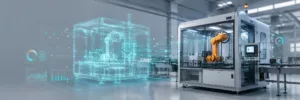
Unexpected equipment failures can stop production, increase maintenance costs, and reduce overall efficiency. A digital twin helps manufacturers identify potential issues before they become major problems. By using real-time data and virtual simulations, businesses can monitor equipment performance, predict failures, and make better operational decisions.
According to Allied Market Research, the global digital twin market in manufacturing is expected to grow from $6.5 billion in 2021 to $125.7 billion by 2030. This growth is driven by increasing adoption of Industry 4.0 technologies across industries such as oil and gas, petrochemicals, automotive, and manufacturing, including businesses across the GCC.
In this guide, you will learn what a digital twin in manufacturing is, how it works, its key benefits, and the most common use cases helping manufacturers improve productivity, reduce downtime, and optimize operations.
What Is a Digital Twin in Manufacturing?
A digital twin is a virtual representation of a physical asset, machine, production line, or manufacturing process. It uses real-time data from sensors and connected systems to reflect the current condition and performance of its physical counterpart. This allows manufacturers to monitor operations, analyze performance, predict failures, and improve decision-making without interrupting production.
Digital twins operate by collecting real-time data from Industrial IoT (IIoT) solutions, sensors, PLCs, SCADA systems, and enterprise software. Unlike a static 3D model or CAD drawing, a digital twin continuously updates as operating conditions change, giving manufacturers an accurate and real-time view of their operations.
Types of Digital Twins in Manufacturing
Manufacturers use different types of digital twins depending on what they want to monitor or optimize. The three main types are:
- Product Twin: A product twin is a virtual model of a physical product. It is used to test designs, improve product performance, and reduce the need for physical prototypes.
- Process Twin: A process twin represents a manufacturing process, such as assembly, welding, or packaging. It helps optimize production, improve efficiency, and identify process issues before they affect operations.
- System Twin: A system twin, also called a factory twin, is a virtual model of an entire manufacturing facility. It provides real-time visibility into operations and helps with production planning, predictive maintenance, and resource optimization.
Benefits of Digital Twin in Manufacturing
A digital twin helps manufacturers improve efficiency, reduce costs, and make better decisions using real-time operational data. Below are the key benefits of implementing digital twin technology:
- Reduces unplanned downtime by predicting equipment failures and supporting condition-based maintenance.
- Speeds up product development by testing and validating designs before building physical prototypes.
- Improves production efficiency by simulating manufacturing processes and identifying opportunities to optimize performance.
- Enables remote monitoring of machines and production lines through real-time data and connected systems.
- Enhances operator training and workplace safety by allowing teams to practice in a virtual environment before working on live equipment.
- Optimizes quality and supply chain performance by identifying production issues early and improving end-to-end visibility.
To build an effective digital twin, manufacturers need reliable data from connected machines and equipment. DCSM’s Industrial IoT Solutions, wireless networking, and system integration services provide the real-time connectivity required to support successful digital twin implementations.
Real World Examples of Digital Twin in Manufacturing
Many global manufacturers use digital twin technology to improve production efficiency, reduce downtime, and optimize operations. Here are a few well-known examples.
Example 1: Siemens Electronics Plant
Siemens uses a digital twin at its Amberg Electronics Plant in Germany to monitor production in real time. The facility processes more than 50 million data points every day and achieves a 99.99885% first pass quality rate while producing over 12 million products annually.
Example 2: GE Aerospace
GE creates a digital twin for every aircraft engine it manufactures. By analyzing operational data from thousands of engines, the company can predict maintenance needs before failures occur. This approach has helped improve engine reliability and reduce unexpected downtime.
Example 3: SABIC
SABIC uses digital twin technology across its petrochemical operations in Saudi Arabia to simulate process changes before implementing them. This helps improve production efficiency, optimize energy consumption, and reduce the risk of costly plant shutdowns.
Example 4: Renault Group
Renault used a factory digital twin to redesign the layout of its Flins manufacturing plant in France. By testing different layouts virtually before making physical changes, the company improved space utilization and reduced material handling costs.
These examples show how digital twins are helping manufacturers make faster decisions, improve product quality, and increase operational efficiency across industries.
How to Implement a Digital Twin in Manufacturing
A successful digital twin implementation requires the right strategy, reliable data, and seamless system integration. Below are the key steps to implement a digital twin in a manufacturing environment.
Step 1: Identify the Right Asset or Process
Start with a high-value asset or a critical production process where downtime or inefficiencies have the biggest business impact. This allows you to validate results before expanding to other areas.
Step 2: Connect Machines with Sensors and IoT
Install the required sensors and connect the equipment via an Industrial IoT solution to collect accurate, real-time data. This data forms the foundation of every digital twin. Our Industry 4.0 implementation services help manufacturers deploy sensors, connectivity, and network infrastructure for reliable data collection.
Step 3: Create the Digital Twin Model
Build a virtual model using engineering drawings, CAD files, and process information. The model should accurately represent the physical asset or production process.
Step 4: Integrate Live Operational Data
Connect the digital model with live data from sensors, SCADA, MES, or ERP systems. This enables the digital twin to continuously monitor equipment performance in real time.
Step 5: Test and Validate the Model
Compare the digital twin’s outputs with actual machine performance and fine-tune the model until it accurately reflects real operating conditions.
Step 6: Deploy Business Use Cases
Once validated, use the digital twin for predictive maintenance, production optimization, quality improvement, energy monitoring, or operator training based on your business goals.
From initial planning to full deployment, DCSM’s Project Management and Digital Transformation services help manufacturers implement digital twin solutions that integrate seamlessly with existing operations and deliver long-term business value.
Conclusion
Digital twin technology in manufacturing is no longer experimental. Companies like Siemens, GE, and SABIC have proven the ROI across some of the world’s most complex production environments. For manufacturers in the GCC looking to improve uptime, quality, and operational efficiency, the question is not whether to implement a digital twin; it is where to start and how to sequence the investment.
DCSM’s Industry 4.0 and IoT solutions provide the data capture and connectivity infrastructure that sits at the heart of every successful digital twin program. With over three decades of experience in GCC industrial environments, DCSM is positioned to support manufacturers from initial sensor deployment through to full digital twin operation.
FAQs on Digital Twin in Manufacturing
What is the difference between a digital twin and a simulation?
A simulation uses fixed data to model a scenario. A digital twin uses real-time data from connected assets to continuously reflect actual operating conditions.
How much does a digital twin implementation cost?
The cost depends on the project scope. A single asset digital twin costs much less than a factory-wide implementation, which requires more infrastructure and system integration.
Can small and medium-sized manufacturers benefit from digital twins?
Yes. Many businesses start with a digital twin for a single machine or production process to reduce downtime and improve maintenance before expanding across the facility.
What data does a digital twin use?
A digital twin uses real-time data from IoT sensors, PLCs, SCADA systems, MES, ERP software, and other connected manufacturing systems.
Do you need AI to run a digital twin?
No. A digital twin can work without AI for monitoring and visualization. However, AI helps improve predictive maintenance, anomaly detection, and performance optimization.
