

Modern manufacturing and logistics operations depend on fast and accurate data capture to keep production moving. As production volumes increase and supply chains become more automated, manual barcode scanning can slow operations and introduce unnecessary errors.
According to GS1, barcode standards are used by more than 2 million companies worldwide, enabling billions of product scans every day across manufacturing, warehousing, retail, and logistics. As businesses adopt Industry 4.0 technologies, they need scanning solutions that can capture data continuously without interrupting production.
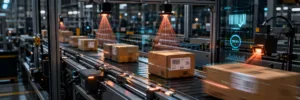
Smart fixed industrial scanners meet this need by automatically reading barcodes and labels as products move through conveyors, assembly lines, and packaging stations. Unlike handheld scanners, they operate without manual intervention and integrate directly with manufacturing and warehouse management systems, improving traceability, productivity, and operational efficiency.
What Is a Smart Fixed Industrial Scanner?
Before exploring how fixed scanners improve automation, it is important to understand what they are and how they differ from conventional barcode scanners.
A smart fixed industrial scanner is a permanently mounted barcode reader that automatically captures one or multiple barcodes as products move through a production line or conveyor system. It combines high-performance imaging, intelligent decoding software, and industrial-grade hardware to deliver reliable barcode reading without requiring an operator to trigger each scan.
Unlike handheld barcode scanners, fixed industrial scanners operate continuously and communicate directly with manufacturing, warehouse, and enterprise systems in real time.
How Does a Fixed Industrial Scanner Work?
A fixed industrial scanner continuously monitors a designated scanning area and automatically captures barcode information whenever a product enters its field of view.
The scanning process typically follows these steps:
- Products move along a conveyor, assembly line, or packaging station.
- The scanner automatically detects the approaching product.
- High-resolution cameras capture one or more images of the barcode.
- Intelligent decoding software reads damaged, low-contrast, rotated, or poorly printed barcodes.
- Barcode data is instantly transmitted to connected MES, WMS, ERP, or PLC systems.
- The connected system updates inventory, production status, traceability records, or routing instructions in real time.
This fully automated process eliminates manual scanning while improving speed and data accuracy.
Types of Smart Fixed Industrial Scanners
Different production environments require different scanning capabilities. Selecting the right scanner depends on conveyor speed, barcode complexity, scanning distance, and environmental conditions.
| Scanner Type | Best For | Typical Applications |
| Single-Sided Fixed Scanner | Reading one barcode from a fixed direction | Assembly lines, packaging stations |
| Multi-Sided Fixed Scanner | Reading barcodes from multiple angles | Distribution centres, parcel sorting |
| High-Speed Industrial Scanner | Fast-moving conveyors | Manufacturing, e-commerce fulfilment |
| Fixed Scanner with Machine Vision | Barcode reading and visual inspection | Quality control, traceability, automated production |
Modern Zebra fixed scanners can also support machine vision applications through software upgrades, allowing manufacturers to expand inspection capabilities without replacing hardware.
Smart Fixed Scanners vs Handheld Barcode Scanners
Although both devices capture barcode data, they are designed for different operational requirements.
| Feature | Handheld Scanner | Smart Fixed Industrial Scanner |
| Operation | Manual | Fully automated |
| Barcode Capture | One item at a time | Continuous inline scanning |
| Production Speed | Depends on operator | Matches conveyor speed |
| Labour Requirement | High | Minimal |
| Integration | Limited | Direct MES, WMS, ERP integration |
| Best Use | Retail, warehouse picking | Manufacturing and automated logistics |
Fixed scanners are the preferred choice wherever products move continuously and accurate real-time tracking is essential.
Benefits of Smart Fixed Industrial Scanners
Beyond automated barcode reading, smart fixed industrial scanners help manufacturers and logistics providers improve operational efficiency, product traceability, and production accuracy.
Key benefits include:
- Continuous barcode capture without manual scanning.
- Higher productivity by eliminating operator bottlenecks.
- Improved traceability across manufacturing and supply chain operations.
- Greater barcode reading accuracy, even for damaged, low-contrast, or poorly printed labels.
- Reduced labor costs by automating repetitive scanning tasks.
- Faster production and warehouse throughput with real-time data capture.
- Scalable automation that supports growing production volumes and Industry 4.0 initiatives.
According to Zebra Technologies, manufacturers are increasingly investing in intelligent automation and real-time visibility solutions to improve operational efficiency and supply chain resilience, making fixed industrial scanners an essential part of modern production environments.
How to Choose the Right Smart Fixed Industrial Scanner
Choosing the right smart fixed industrial scanner depends on your production environment, barcode quality, conveyor speed, and system integration requirements. Evaluating these factors before deployment helps ensure reliable barcode capture and long-term operational performance.
When selecting a solution, consider the following:
- Scanning requirements: Determine the barcode types, label quality, and reading distance your application requires.
- Production speed: Choose a scanner that can accurately capture barcodes at your conveyor or production line speed.
- Environmental conditions: Select industrial-grade scanners designed to operate reliably in dusty, humid, or high-temperature environments.
- System integration: Ensure the scanner can integrate with existing MES, WMS, ERP, PLC, or warehouse automation systems.
- Future scalability: Consider solutions that support software upgrades, machine vision capabilities, or expanding production requirements without replacing hardware.
- Technical support: Work with an experienced implementation partner that provides system design, installation, integration, training, and ongoing support.
DCS helps manufacturers and logistics providers evaluate their operational requirements and deploy Zebra fixed industrial scanning solutions that integrate seamlessly with existing production and warehouse systems.
Summing Up
Accurate barcode data is the foundation of efficient manufacturing and supply chain operations. Smart fixed industrial scanners enable organizations to capture that data automatically, reducing manual effort while improving visibility across production and warehouse processes. Whether the goal is enhancing product traceability, increasing conveyor throughput, or supporting warehouse automation, choosing the right scanning solution can deliver measurable improvements in productivity, accuracy, and operational performance.
FAQs on Fixed Industrial Scanners
What is a smart fixed industrial scanner?
A smart fixed industrial scanner is a permanently mounted barcode reader that automatically captures barcode data from products moving through conveyors, production lines, or packaging stations. It operates continuously without requiring manual scanning.
What is the difference between a fixed scanner and a handheld scanner?
A handheld scanner requires an operator to scan each barcode manually, while a fixed industrial scanner performs automatic, continuous barcode reading as products move through the scanning area. Fixed scanners are ideal for high-speed manufacturing and warehouse automation.
Can fixed industrial scanners read damaged or poorly printed barcodes?
Yes. Modern smart fixed scanners use advanced imaging and intelligent decoding algorithms to accurately read damaged, low-contrast, scratched, or partially obscured barcodes that traditional scanners may fail to detect.
Which industries use smart fixed industrial scanners?
These scanners are widely used in manufacturing, logistics, warehousing, automotive, food and beverage, pharmaceuticals, retail distribution, electronics, and e-commerce fulfilment centres where automated barcode tracking is essential.
