

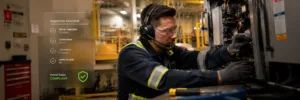
A technician climbing through an aircraft engine bay with a clipboard in one hand and a torch in the other is not just slow. It is a compliance risk waiting to surface at the next audit. Every paper checklist skipped, every reading transcribed later from memory, is a gap an auditor can find. Honeywell Voice Maintenance and Inspection closes that gap by letting technicians work with both hands free and both eyes on the equipment, while the system captures every finding in real time. DCSME works with Honeywell to deliver this voice-enabled maintenance and inspection solution across the UAE and wider GCC.
Honeywell Voice Maintenance and Inspection (M&I) is a hands-free, eyes-free voice technology that guides technicians through maintenance and inspection checklists using spoken commands. Instead of writing findings on paper or typing them into a handheld device, technicians speak their observations directly into the system through a headset, and the platform logs, timestamps, and stores every response automatically.
Key Takeaways
- Honeywell Voice Maintenance and Inspection replaces paper and handheld checklists with spoken, hands-free workflows that log data as the inspection happens.
- Honeywell voice solutions integrate with existing ERP or Enterprise Asset Management systems, so voice data feeds straight into the platforms teams already use.
- Voice-assisted maintenance reduces skipped steps, cuts training time for new technicians, and standardizes how inspections are performed across shifts and sites.
- Documented pilots show measurable gains: one fleet operator reduced inspection time by close to 25% and improved quality by 3%.
- DCSME implements and supports Honeywell voice technology across aviation, manufacturing, and logistics operations in the UAE and GCC.
How Does Honeywell Voice Maintenance and Inspection Work?
Industrial voice solutions built on Honeywell’s platform sit between the technician and the host data system, usually an ERP or EAM. Instead of a technician stopping work to write down a reading, the system prompts each step by voice and records the spoken response as structured data.
To understand why this solution improves maintenance quality and compliance, let us look at how the complete voice guided workflow operates in practice:
- The technician puts on a headset connected to a mobile voice terminal.
- The system reads out each inspection or maintenance step in sequence.
- The technician speaks about the finding, confirms a reading, or flags an exception verbally.
- The system timestamps and stores the response and displays supporting images or reference data when needed.
- Completed checklists sync automatically to the connected ERP or EAM platform, with no manual re-entry.
This is why the workflow is often described as hands-free, eyes-free: the technician never has to put down a tool or look away from the equipment to log a result. The maintenance process follows a structured sequence where each stage replaces a manual task with a voice driven alternative, as shown below:
| Step in Workflow | What Changes vs Paper or Handheld |
| Recording a finding | Spoken directly into headset instead of written or typed |
| Reviewing procedure | System reads next step aloud instead of technician reading a form |
| Data entry | Automatic and real-time instead of a separate post-inspection task |
| Audit trail | Timestamped and system-logged instead of reconstructed from notes |
What Makes Voice Workflow Automation Improve Compliance?
Compliance failures rarely come from technicians not knowing the procedure. They come from steps skipped under time pressure, or from findings transcribed later and reconstructed from memory. Voice workflow automation removes both failure points by making the checklist itself the data entry mechanism.
Because the technician must respond to each prompt before the system moves to the next step, it becomes far harder to skip a step without it showing up in the log. Every finding is captured at the moment of inspection, not written up afterward, so the record reflects what was actually observed rather than what someone recalled at the end of a shift.
These improvements directly impact technician performance and audit readiness through features such as:
- Consistent SOP adherence: Every technician is guided through the same sequence in the same order, regardless of experience level
- Real-time documentation: Findings are logged the instant they are spoken, removing the lag between inspection and record
- Faster technician onboarding: New hires follow the same voice-guided steps as experienced staff from day one
- Built-in audit trail: Every checklist, timestamp, and technician response is stored automatically for compliance reporting
Regulated environments such as aviation MRO, fleet maintenance, and manufacturing plants carry the heaviest documentation burden, and this is where voice-assisted maintenance shows up most often in the field. In aviation maintenance and inspection, for instance, the same voice-directed model applies to engine MRO, avionics checks, and line maintenance, where every step must be traceable back to a named technician and a timestamp.
Which Industries Use Honeywell Voice Solutions?
Honeywell voice technology was originally built for warehouse and distribution environments, but the maintenance and inspection application has moved well beyond the warehouse floor. The following table highlights how different industries use Honeywell voice technology and the key benefits they achieve:
| Industry | What Gets Voice-Guided | Primary Benefit |
| Aviation MRO | Engine, APU, avionics, and component inspection | Faster turnaround, traceable compliance records |
| Fleet and Transportation | Vehicle inspection, preventive maintenance checklists | Reduced inspection time, consistent documentation |
| Manufacturing | Machinery inspection, safety checklists | Fewer skipped steps, faster training |
| Oil and Gas | Equipment and pipeline inspection rounds | Hands-free operation in hazardous zones |
| Warehouse and Logistics | Equipment checks, safety walkthroughs | Standardized SOPs across shifts |
A UK-based construction equipment manufacturer that deployed the solution to digitize inspection of its industrial machinery reported higher worker productivity, improved safety, and inspection times cut roughly in half after adoption. A separate fleet-leasing operator using Honeywell Voice for vehicle inspection projected close to a 25% reduction in total inspection time along with a 3% quality improvement, translating into fewer unplanned repairs.
Across the GCC, aviation and logistics operators face some of the strictest documentation requirements in the region, from civil aviation authority inspections to fleet safety audits. For operations already running an enterprise asset management platform, voice data flows directly into existing maintenance records without adding a parallel system to manage.
DCSME and Honeywell: Bringing Voice-Guided Compliance to the GCC
DCSME works with Honeywell to deliver voice-enabled maintenance and inspection solutions across the UAE, Saudi Arabia, and the wider GCC. Rather than treating this as an off-the-shelf install, DCSME scopes the deployment around the customer’s existing checklists, host systems, and compliance requirements, then manages implementation, integration, and ongoing support.
Why Businesses Across the Middle East Choose DCSME for Voice Deployments
Organizations choose DCSME for several reasons that go beyond product implementation, such as:
- Deep implementation experience across aviation, manufacturing, and logistics environments in the region
- Integration expertise connecting voice data with existing ERP and EAM platforms
- Local support and training so technicians are productive from day one
- A single point of accountability for both the Honeywell technology and the surrounding workflow
A leading regional airport ground services provider that moved from paper-based inspection logs to a voice-guided workflow found its compliance audits went from a multi-day reconstruction exercise to a same-day export from the system.
The question worth asking is not whether voice technology fits a maintenance operation. It is how many hours a compliance team currently spends reconstructing paper records that a voice-guided checklist would have captured automatically.
Frequently Asked Questions
What is Honeywell Voice Maintenance and Inspection?
The distinction most people miss is that this is not voice-to-text software bolted onto an existing checklist app. It is a directed workflow: the system prompts the next step, waits for a spoken response, and only advances once that response is captured. That sequencing is what prevents skipped steps, not the voice interface by itself.
How does Honeywell voice technology integrate with existing systems?
The part that determines whether a deployment succeeds is the integration layer, not the headset. Voice M&I is designed to sit on top of an existing ERP or EAM system, so the checklist logic and asset data still live where they always did. Teams that skip mapping this integration early often end up with a voice system that works but still requires manual reconciliation afterward, which defeats the purpose.
Which industries benefit most from voice-assisted maintenance?
Aviation MRO and fleet maintenance see the fastest documented gains because their compliance requirements are the strictest and their inspection volumes are highest, so even a modest per-inspection time saving compounds quickly. Manufacturing and oil and gas follow closely, largely because hands-free operation also has a direct safety benefit in those environments.
Does voice maintenance and inspection replace the technician’s judgment?
No. The system is a workflow guide and a data-capture layer, not a decision-maker. A technician who identifies a genuine exception still flags it verbally and can be routed to a supervisor or a different checklist branch. What changes is that the exception is logged the moment it is found instead of written on a slip of paper that may or may not make it into the final report.
What does a typical Honeywell Voice deployment involve?
Deployments generally start with mapping the existing checklist and identifying which host system the voice data needs to feed into, followed by a pilot on one line, fleet, or facility before wider rollout. Organizations that skip the mapping step tend to discover integration gaps mid-deployment rather than before it, which is why DCSME scopes this stage before recommending hardware.
