

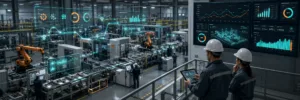
Every production floor generates enormous amounts of data. Most manufacturers capture very little of it. Of what they do capture, even less reaches a decision-maker in time to act. The average manufacturing plant still reviews production performance on a daily or weekly basis, by which point the opportunity to correct a problem has long passed.
Real-time manufacturing analytics changes this fundamental dynamic. According to McKinsey, manufacturers that implement real-time production monitoring and analytics programs achieve 10–20% improvements in equipment utilization and 15–25% reductions in quality defect rates. In an industry where margins are tight and competitive pressure is relentless, these are not marginal gains. They are transformational.
This guide explains what real-time manufacturing analytics entails, why it matters, how it improves production efficiency in practice, and the steps to move from lagging reports to live operational intelligence.
What is Real-Time Manufacturing Analytics?
Real-time manufacturing analytics is the process of collecting and analyzing production data as it is generated. It gathers information from machines, sensors, production systems, and operators to provide live insights through dashboards, reports, and alerts. This helps manufacturers monitor operations, identify issues quickly, and make faster decisions.
Unlike traditional reporting, which reviews data after production is complete, real-time manufacturing analytics provides instant visibility into production performance. Our Data Science and Analytics solutions help manufacturers collect, analyze, and visualize real-time production data to improve efficiency, product quality, and operational performance.
Importance of Real-Time Manufacturing Analytics
Real-time manufacturing analytics helps businesses make faster and more informed decisions. Here is why it has become essential for modern manufacturing operations:
Why Batch Reporting Is No Longer Sufficient
Manufacturing has changed. Production runs are shorter. Product variety is higher. Customer expectations for lead time and quality are more demanding than they were a decade ago. The production environment for which batch reporting was designed has been largely replaced by one that requires minute-by-minute visibility.
Consider the economics of delayed information in a typical GCC manufacturing scenario:
- A machine running at 85% of its target speed loses 15% of its planned output per shift
- Without real-time monitoring, this deviation may not be flagged until end-of-shift reporting
- A ten-hour shift at 85% speed loses 1.5 hours of effective production
- At a blended production rate of $500 per hour, that is $750 of output lost per shift, per machine
Scale that across a facility with twenty machines over 250 working days, and the delayed detection of common performance deviations costs millions annually.
The Competitive Case for Real-Time Data
Manufacturers competing for contracts in the GCC, particularly in oil & gas supply chains, defense, and government procurement, face increasingly stringent quality and delivery performance requirements. Real-time analytics provides the documented evidence of production performance that major customers now require as part of supplier qualification.
In DCSM’s experience working with manufacturing clients across the UAE, Saudi Arabia, and the broader GCC, the ability to provide live production data and quality traceability has become a genuine commercial differentiator in enterprise sales cycles.
Benefits of Real-Time Manufacturing Analytics
Real-time manufacturing analytics helps businesses improve production efficiency, reduce operational costs, and make faster decisions. Below are some of the key benefits manufacturers can achieve:
Improved Overall Equipment Effectiveness (OEE)
Real-time analytics continuously tracks machine availability, performance, and product quality. This helps manufacturers identify production losses quickly and improve Overall Equipment Effectiveness (OEE). An IoT solutions automatically collect machine data to provide accurate OEE dashboards without manual data entry.
Faster Root Cause Analysis
When production or quality issues occur, real-time data helps identify the exact cause by analyzing machine performance, production parameters, and operational data. This reduces troubleshooting time and helps prevent recurring problems.
Reduced Downtime with Predictive Maintenance
By monitoring machine conditions such as vibration, temperature, and pressure, manufacturers can detect potential failures before they happen. This reduces unplanned downtime, lowers maintenance costs, and improves equipment reliability.
Lower Energy Consumption
Real-time energy monitoring helps identify unnecessary energy usage, equipment inefficiencies, and utility waste. This allows manufacturers to optimize energy consumption and reduce operating costs.
Better Production Planning
Live production data provides planners with accurate information on machine availability, production progress, and work in progress. This improves production scheduling, resource allocation, and on-time order delivery.
Improved Shop Floor Productivity
Operators and supervisors can view live production dashboards to monitor performance, quality, and downtime in real time. This increases visibility, supports faster decision-making, and improves overall shop floor productivity.
Real-Time Production Monitoring in Manufacturing: Key Components
Building a real-time production monitoring capability requires several integrated components:
- Machine Data Connectivity: This is the foundational layer. Machines must transmit data — either through existing OPC-UA interfaces on modern equipment, or through retrofitted IIoT sensors on older machines. Many GCC manufacturers have production equipment that is ten to twenty years old and was never designed to network. Retrofitting these assets with sensors is a common starting point.
DCSM’s Industry 4.0 team specializes in connecting legacy industrial equipment to modern data platforms — a critical capability in a region where much manufacturing infrastructure predates Industry 4.0 technologies.
- Industrial Networking Infrastructure: Machine data needs a reliable, low-latency network to reach processing systems. Industrial wireless networks built on Wi-Fi 6 or private 5G standards provide the coverage and reliability that real-time analytics requires.
DCSM’s Wireless and Networking solutions are designed and validated for industrial environments, including the temperature extremes, interference, and security requirements specific to GCC manufacturing and petrochemical facilities.
- Edge Computing: Processing some data at the edge — close to the machine — reduces latency for time-sensitive alerts and reduces the volume of raw data transmitted to central systems. An edge gateway near a production line can filter, aggregate, and pre-process sensor data before forwarding relevant events to cloud or on-premise analytics platforms.
- Data Integration Layer: Real-time production analytics is most powerful when machine data is combined with ERP data (production orders, material batches, customer commitments) and quality system data. This integration requires middleware that can pull data from disparate systems and present it in a unified analytical environment.
- Analytics Platform and Dashboards: The final layer and the one most visible to end users is the dashboard and analytics application. Effective real-time production dashboards show:
- Current OEE by line and machine
- Live production count vs. target
- Active downtime events with elapsed time
- Real-time quality metrics and exception flags
- Energy consumption vs. baseline
- Shift performance trend vs. historical benchmark
DCSM’s Data Science and Analytics practice builds and implements these analytical applications, integrating them with plant data sources and enterprise systems.
How to Implement Real Time Manufacturing Analytics
Implementing real time manufacturing analytics requires a structured approach. Below are the key steps to build an effective analytics system.
Step 1: Define clear business goals such as reducing downtime, improving product quality, increasing production efficiency, or lowering operating costs.
Step 2: Connect critical machines and equipment using IoT sensors to collect accurate real time production and performance data.
Step 3: Build a secure and reliable network so production data can flow continuously between machines, sensors, and analytics platforms.
Step 4: Integrate machine data with MES, ERP, SCADA, and other manufacturing systems to create a single view of operations.
Step 5: Create live dashboards and automated alerts that help operators and managers monitor performance and respond quickly to production issues.
Step 6: Continuously review production data, measure key performance indicators, and expand the analytics solution across more machines and production lines as your business grows.
DCSM helps manufacturers implement real-time manufacturing analytics by integrating IoT devices, production systems, and data analytics into a single connected manufacturing platform.
Final Thoughts
Real-time manufacturing analytics gives manufacturers the visibility they need to make faster and better decisions. By collecting and analyzing live production data, businesses can reduce downtime, improve product quality, optimize production, and increase overall operational efficiency.
Whether you are beginning your digital transformation journey or upgrading existing manufacturing systems, implementing real-time analytics can create long-term value across your operations. DCSM helps manufacturers build connected production environments by integrating Industrial IoT, manufacturing systems, and advanced analytics into a single platform, enabling smarter decisions and continuous operational improvement.
Frequently Asked Questions
What data is used in real-time manufacturing analytics?
Real-time manufacturing analytics uses data from IoT sensors, machines, PLCs, SCADA systems, MES, ERP software, quality inspection systems, and energy monitoring devices.
How long does it take to implement real-time manufacturing analytics?
A small implementation can be completed in 8 to 12 weeks, while a full factory deployment may take 6 to 12 months, depending on the project size.
What is the difference between real-time analytics and business intelligence?
Business intelligence analyzes historical data to generate reports. Real-time analytics monitors live production data, providing instant insights and alerts to enable faster decision-making.
Can real-time analytics work with older manufacturing equipment?
Yes. Older machines can be connected using IoT sensors and edge devices, allowing manufacturers to collect real-time data without replacing existing equipment.
What KPIs should a real-time manufacturing dashboard include?
Common KPIs include Overall Equipment Effectiveness (OEE), machine downtime, production output, product quality, energy consumption, and production efficiency.
