

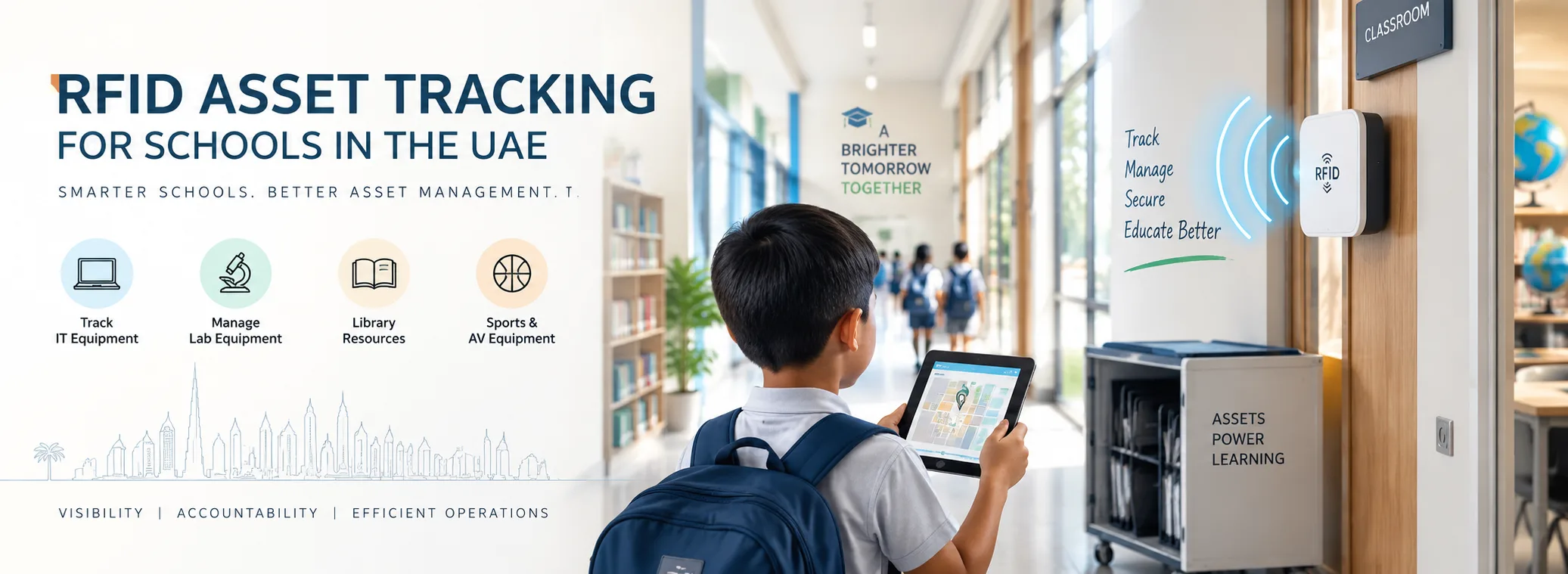
A school may have hundreds or even thousands of physical assets spread across classrooms, laboratories, libraries, offices, and storage areas. Laptops move between departments, lab equipment is shared between classes, and furniture or AV equipment can change locations without the asset register being updated. Over time, these movements can create gaps between recorded information and the actual location of an asset.
This is where RFID asset tracking for schools can make a practical difference. RFID uses radio waves to identify tagged assets without requiring a direct line of sight, allowing schools to capture asset movements more efficiently than manual scanning. Schools can install RFID readers at entry points, storage areas, or other key locations, while handheld readers can support regular inventory audits.
The real value comes from connecting RFID data with an organised asset management process. Schools can track what they own, where assets are located, when they move, and who is responsible for them. DCS provides RFID and asset-tracking solutions, along with inventory management software, tagging services, automated stock-taking, and asset management capabilities.
Why Schools Need a Tracking System Rather Than a Spreadsheet
A spreadsheet can provide a useful starting point for maintaining an asset register. As schools grow and assets move between classrooms, departments, and campuses, a dedicated tracking system can provide greater visibility and consistency.
For example, a projector may move from Classroom 4 to the science lab for a demonstration, while a set of lab instruments may be redistributed between departments at the start of a term. A laptop cart shared by several grade levels may also move frequently throughout the day.
A more automated approach can address common operational challenges such as:
- Assets moving between classrooms with limited visibility of their latest location.
- Manual inventory checks requiring significant staff time.
- Asset ownership and check-out records requiring regular updates.
- Maintenance schedules depending heavily on manual reminders.
- Annual audits requiring considerable administrative effort.
RFID works alongside a strong asset policy by making asset identification, movement tracking, and inventory checks more efficient.
How RFID Tracking Works in a School Setting
Each asset, such as a laptop, lab device, library book, or piece of sports equipment, receives a tag with a unique identification number.
- Asset management software registers the tag ID along with information such as purchase date, department, and assigned user.
- Fixed RFID readers installed at classroom doors, lab entrances, or storage areas can detect tagged items as they move through designated points.
- Handheld readers allow staff to scan multiple tagged assets during scheduled inventory checks.
- The asset management system can update location and status information and generate alerts based on predefined movement or access rules.
DCS’s EAM solution supports asset identification through barcode, RFID, and BLE technologies, along with movement tracking, check-in/check-out processes, maintenance information, reporting, and ERP integration.
| Step | Traditional Tracking | RFID-Enabled Tracking |
| Asset moves between rooms | Staff update the location manually | Movement can be captured through RFID readers |
| Inventory audit | Staff locate and count assets individually | Handheld readers can capture multiple tagged assets in one pass |
| Asset location | Based on the latest recorded update | Latest reader location can provide additional visibility |
| Asset movement | Recorded through manual check-in/check-out | RFID can support automated movement tracking at designated points |
What Assets Are Worth Tagging First
Schools can begin with asset categories where movement, replacement cost, or accountability makes tracking especially valuable. This allows the RFID programme to start with a focused scope and expand over time.
- IT equipment: Laptops, tablets, desktops, projectors, and interactive smart boards.
- Laboratory equipment: Microscopes, measuring instruments, and shared lab tools used across classes.
- Library resources: Books, journals, and other materials managed through regular check-in and check-out.
- AV and event equipment: Microphones, speakers, portable screens, and other equipment shared across venues.
- Sports equipment and musical instruments: Frequently moved items that benefit from stronger inventory visibility.
- School transport assets: Buses and related equipment where asset identification and location visibility are important.
Starting with high-value, frequently moved assets lets schools establish the process, measure benefits, and gradually expand coverage.
What Changes Operationally Once RFID Is in Place
Once RFID is implemented, schools can manage assets with greater visibility, accuracy, and efficiency:
- Faster audits: Handheld RFID readers can capture multiple tagged items in one pass, reducing the time required for inventory checks.
- Better accountability: The system records asset check-out and assignment information, making responsibility easier to manage.
- Scheduled maintenance: Schools can set maintenance reminders based on usage or service intervals.
- Better movement visibility: RFID readers at selected entry and exit points can record tagged assets moving between designated areas.
- Simpler library management: RFID-enabled check-in and check-out can streamline borrowing, due dates, and inventory records.
- More accurate asset records: Automated data capture keeps asset information closer to equipment movement and status.
Where This Fits Into UAE School Priorities
Schools across the UAE are increasingly using technology to improve campus operations, manage resources, and create more connected environments. As the number of digital devices, laboratory assets, shared equipment, and other physical resources grows, maintaining accurate asset information becomes an important part of day-to-day administration.
RFID can support this operational layer by giving schools greater visibility into asset locations and movements. For multi-campus school groups, the same approach can provide a central view of assets across different locations, making inventory checks, movement management, and reporting more consistent.
DCS also works across connected operational environments, combining RFID, software, IoT, networking, and asset management capabilities. Its EAM solution can track assets through RFID, barcode, or BLE and support movement management, maintenance, reporting, and integration with platforms such as SAP and Oracle.
Why UAE Schools Choose DCSME for RFID Asset Tracking
DCSME brings together RFID, asset management software, inventory services, and integration capabilities to support organisations with large and frequently moving asset inventories:
- DCSME provides RFID and barcode tagging services for asset identification.
- Its asset management solutions support movement tracking, check-in/check-out, maintenance, and reporting.
- RFID and inventory data can be integrated with enterprise systems such as SAP and Oracle.
- Schools can begin with selected asset categories and expand the solution as their requirements develop.
- DCSME can support physical inventory, cycle counts, tagging, reporting, and inventory management as part of a wider implementation.
For organisations looking to connect asset tracking with broader inventory operations, DCSME also provides a Warehouse Management System with barcode and RFID capabilities, real-time inventory visibility, movement tracking, and ERP integration.
Ready to Know Where Your School’s Assets Are?
DCSME can assess your current asset environment and recommend a phased RFID approach based on the types of assets you manage, their movement patterns, and your existing systems.
The solution can bring together asset tagging, inventory management, movement tracking, physical inventory, reporting, and system integration. DCSME’s Enterprise Asset Management solution is designed to manage assets across their lifecycle, from acquisition and assignment through maintenance and retirement.
Speak to a DCSME specialist or call (+971) 42946086.
Frequently Asked Questions
Does RFID asset tracking require replacing our current inventory system?
RFID can work alongside an existing asset register or inventory system. DCS solutions can also integrate with enterprise platforms such as SAP and Oracle, depending on the project requirements.
How long does it take to tag an entire school’s inventory?
The timeline depends on the number and type of assets, the tagging approach, and the implementation scope. Many organisations begin with selected asset categories before expanding the system across a wider inventory.
Can students remove or tamper with RFID tags?
Tag placement and asset type influence durability. Schools can use suitable tag types and discreet placement for different equipment, supported by periodic inventory checks and asset management procedures.
Is RFID tracking useful for schools with a few hundred assets?
Yes. RFID can be valuable for schools of different sizes, particularly where assets are frequently shared or moved between classrooms, departments, laboratories, and storage areas.
What is the difference between RFID and barcode tracking for schools?
Barcode systems typically require line-of-sight scanning, while RFID can identify multiple tagged items without directly viewing each tag. This makes RFID particularly useful for faster inventory checks and movement tracking across larger asset inventories.
Can RFID tracking support asset maintenance?
Yes. When RFID identification is connected with an asset management system, schools can maintain asset records alongside maintenance schedules, service history, and other relevant information. DCS’s EAM solution supports asset maintenance and lifecycle management capabilities.
