

Hospitality businesses juggle countless daily tasks, from processing guest payments to managing vendor invoices and generating reports. These repetitive tasks often lead to frustration and affect customer experience.
Robotic Process Automation (RPA) for hospitality offers a smart solution by automating billing, invoicing, and administrative workflows. From RPA billing systems that eliminate manual payment errors to automated invoice processing, let’s understand how RPA is transforming the hospitality industry.
What is RPA, and why is it Important in GCC?
RPA automates repetitive tasks like data entry and processing payments quickly and accurately using software robots.
Due to the increase in the tourists’ footfall in the last few decades, the pressure on the hospitality industry has increased in the GCC region. With various ambitious projects like Vision 2030, hotels adopting RPA will gain competitive advantages through faster response times, reduced errors, and improved guest experiences, especially meeting the sophisticated expectations of international visitors.
The Future of RPA in Hospitality: AI-Powered Intelligent Automation
The next evolution of RPA combines robotic process automation with artificial intelligence (AI) and machine learning (ML) to handle unstructured data, make predictions, and learn from patterns. Here’s how AI-powered RPA is transforming hospitality.
AI Chatbots for Guest Service
AI-driven chatbots integrated with RPA can handle guest inquiries 24/7, process booking modifications, recommend room upgrades, and escalate complex issues to human staff. Hotels using AI chatbots report 30–50% reduction in front-desk call volume.
Predictive Maintenance with IoT and RPA
RPA bots connected to IoT sensors (HVAC, elevators, plumbing) use machine learning to predict equipment failures before they occur. Bots automatically schedule maintenance, order parts, and notify technicians—reducing downtime by 40%.
Sentiment Analysis for Reputation Management
AI-powered RPA scans guest reviews across TripAdvisor, Google, and Booking.com, analyzes sentiment (positive, negative, neutral), and identifies recurring complaints (e.g., slow check-in, room cleanliness). This helps hotels prioritize operational improvements.
Dynamic Pricing with Machine Learning
AI algorithms analyze historical occupancy, competitor rates, local events, and weather forecasts to recommend optimal room pricing in real time. RPA bots then update rates across all distribution channels (OTAs, direct booking site) automatically, maximizing revenue per available room (RevPAR).
Why RPA is a Must for the Hospitality Industry?
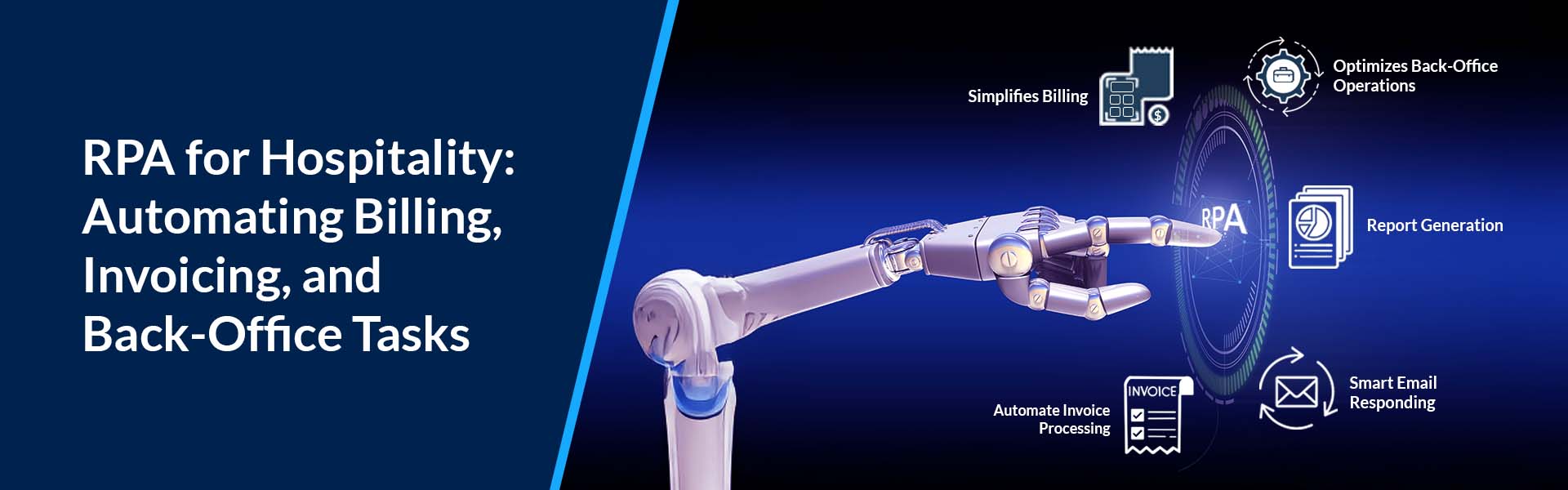
The answer is straightforward. RPA increases productivity. Here are some of the amazing things that it can do without much human intervention.
Automate Invoice Processing: An RPA bot can pull billing details from different systems, like a hotel management system or a booking website, and add applicable taxes, creating error-free invoices automatically.
Simplifies Billing: RPA verifies payments across various payment methods, including credit cards, and instantly updates guest details, processes refunds, or handles complex group bookings.
Optimizes Back-Office Operations: It handles different types of office automations, including data entry, HR processing, vendor management, compliance, and reporting. Moreover, IT tasks like data backup and user account management are also effortlessly handled by RPA.
Report Generation: Instead of staff manually fetching data from various sources, the RPA system can generate weekly, monthly, or quarterly reports in minutes. It collects data from various systems, including point-of-sale terminals and accounting software, and organizes it in a spreadsheet.
Smart Email Responding: These smart bots understand the content of incoming emails and process the required tasks, such as reservation confirmations, by sending appropriate responses using pre-approved templates.
Real-World Use Cases of RPA in Hospitality
Here are the most impactful ways hotels and resorts in the GCC are deploying RPA to streamline operations and enhance guest satisfaction.
1. Reservation and Booking Management
RPA bots automatically extract booking data from OTAs (Expedia, Booking.com), travel agencies, and direct website reservations, then populate the Property Management System (PMS) without manual data entry. Bots verify room availability, apply dynamic pricing rules, and send instant confirmation emails to guests. This reduces booking errors by up to 95% and accelerates reservation processing by 60%.
2. Housekeeping and Room Status Automation
When a guest checks out, RPA bots instantly update the housekeeping management system, assign cleaning tasks to staff, and track room readiness in real time. Integration with IoT sensors (occupancy, minibar usage) allows bots to trigger maintenance requests automatically. Hotels report a 40% reduction in room turnaround time.
3. Revenue Management and Competitor Pricing Analysis
RPA bots continuously monitor competitor rates across booking platforms, analyze occupancy trends, and adjust room pricing dynamically to maximize revenue per available room (RevPAR). Bots generate daily revenue reports and flag anomalies (e.g., sudden rate drops) for human review. This automation improves pricing accuracy and can increase revenue by 15–25%.
4. Regulatory Compliance and Audit Reporting
In the GCC, hotels must comply with VAT regulations, tourism levies, and labor laws. RPA bots extract transaction data from PMS and accounting systems, validate compliance with local tax codes, and generate audit-ready reports for government authorities. This reduces compliance errors and saves 30+ hours per month in manual reporting.
5. Guest Feedback and Reputation Management
RPA bots scan online reviews (TripAdvisor, Google, Booking.com), categorize sentiment (positive, negative, neutral), and route complaints to the guest relations team. Bots can auto-respond to common queries and track resolution times. Hotels using RPA for reputation management see a 20% improvement in online ratings within six months.
How to Implement RPA in Your Hospitality Business: Best Practices
Successfully deploying RPA requires a structured approach. Here’s how hotels in the GCC can get started.
Step 1: Identify High-Volume, Rule-Based Processes
Start by mapping workflows that are repetitive, time-consuming, and prone to human error—such as invoice data entry, payment reconciliation, and report generation. Prioritize processes with clear rules and minimal exceptions.
Step 2: Choose the Right RPA Vendor and Tools
Evaluate RPA platforms like UiPath, Automation Anywhere, Blue Prism, and Microsoft Power Automate. Look for vendors with hospitality-specific templates, PMS integrations (Opera, Protel, Mews), and local support in the GCC. Request a proof-of-concept before committing.
Step 3: Run a Pilot Program
Deploy RPA for one process (e.g., invoice processing) in a single property. Measure time savings, error reduction, and ROI over 30–60 days. Use pilot results to secure buy-in from stakeholders and refine bot configurations.
Step 4: Train Staff and Manage Change
RPA is not about replacing employees—it’s about freeing them for higher-value tasks like guest engagement. Conduct training sessions to help staff understand how bots work, how to monitor them, and how to escalate exceptions.
Step 5: Scale Across Properties and Processes
Once the pilot succeeds, roll out RPA to additional properties and workflows (housekeeping, revenue management, compliance). Establish a Center of Excellence (CoE) to govern bot development, monitor performance, and share best practices across your hotel group.
Top RPA Solutions for Hospitality
Choosing the right RPA platform is critical for successful automation. Here’s a comparison of leading RPA solutions used by hotels and resorts worldwide.
| RPA Platform | Key Features | Best For | PMS Integration |
|---|---|---|---|
| UiPath | Drag-and-drop bot builder, AI/ML integration, cloud & on-premise deployment | Large hotel chains, complex workflows | Opera, Protel, Mews, Cloudbeds |
| Automation Anywhere | Web-based, IQ Bot for unstructured data, enterprise scalability | Mid-to-large hotels, invoice processing | Opera, SAP, Oracle Hospitality |
| Blue Prism | Enterprise-grade security, centralized control room, compliance-focused | Hotels with strict regulatory requirements (GCC, EU) | Opera, Protel, custom APIs |
| Microsoft Power Automate | Low-code, integrates with Office 365 & Dynamics, affordable | Small-to-mid-sized hotels, budget-conscious operators | Mews, Cloudbeds, RMS, custom connectors |
| Data Capture Systems (DCS) | GCC-focused, Arabic language support, local implementation & support | Hotels in UAE, Saudi Arabia, Qatar, Bahrain | Opera, Protel, local PMS systems |
For hotels in the GCC, partnering with a regional provider like Data Capture Systems ensures faster implementation, local compliance expertise, and Arabic-language support.
Benefits of RPA
Let’s quickly understand RPA benefits with a simplified table.
| Benefit Category | Impact | Measurable Outcomes |
|---|---|---|
| Cost Reduction | Error-related cost, Manual labor | 25-40% |
| Time Efficiency | Quick invoice creation and report creation | Up to 70% |
| Accuracy Improvement | Maintain billing uniformity and reduce human error | 99.9% accurate |
Conclusion
Hotels and hospitality businesses in the GCC regions like the UAE, Qatar, and Saudi Arabia deal with countless repetitive tasks every single day – from processing guest bills to generating reports and responding to routine emails. With RPA, businesses can stay ahead of the competition by delivering error-free and quick service that lets guests keep coming back.
Want to adopt RPA for your hospitality business and don’t know where to start? Let Data Capture Systems (DCS) be at your service. Being one of the best technology providers in the GCC, we offer a complete automation solution. Reach out to our team to know more.
