

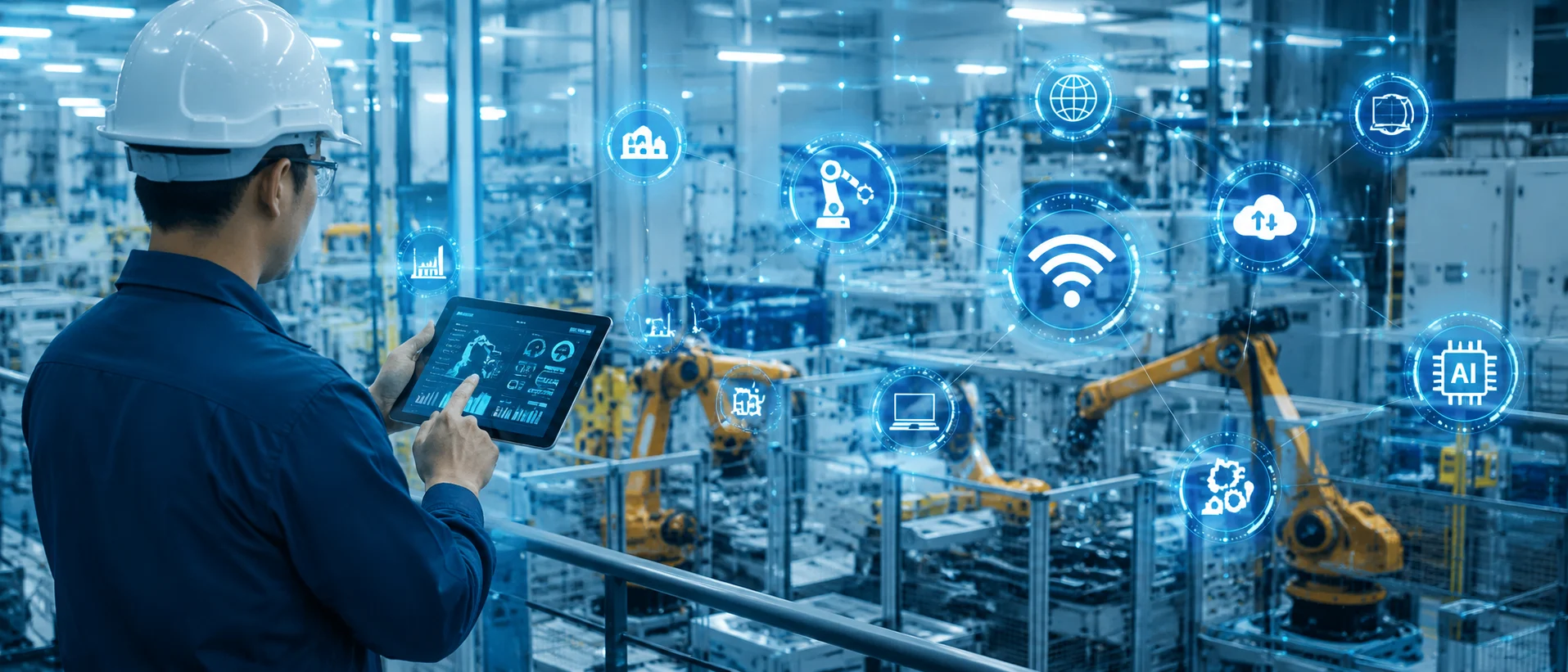
Manufacturers are under constant pressure to improve productivity, reduce costs, and increase operational efficiency. Traditional production methods that rely on manual processes and disconnected systems often make it difficult to achieve these goals. Smart factories solve this challenge by connecting machines, systems, and people through digital technologies that enable real-time monitoring and data-driven decision-making.
According to the World Economic Forum, smart factory technologies could add $3.7 trillion in value to the global manufacturing sector by 2025. As a result, manufacturers across the GCC are increasingly investing in smart factory initiatives as part of their Industry 4.0 and digital transformation strategies.
A 2025 Deloitte study found that manufacturers who successfully implement smart factory technologies achieve an average of 20% improvement in operational efficiency within the first 18 months. As a result, manufacturers across the GCC are increasingly investing in smart factory initiatives as part of their Industry 4.0 and digital transformation strategies.
In this guide, you will learn what a smart factory is, the technologies that power it, its key benefits, and the steps to successfully implement a smart factory in your manufacturing operations.
What Is a Smart Factory?
A smart factory is a manufacturing facility where machines, systems, and people are connected through digital technologies. It uses real-time data, automation, and connected devices to monitor production, improve efficiency, reduce downtime, and support faster decision-making.
Smart factories are a key part of Industry 4.0, combining technologies such as Industrial IoT, artificial intelligence, cloud computing, and automation to create connected and intelligent manufacturing operations. Our Industry 4.0 solutions help manufacturers build this connected environment by integrating machines, data, and enterprise systems into a single digital ecosystem.
Emerging Smart Factory Technologies in 2026
As smart factories mature, manufacturers are adopting next-generation technologies that move beyond basic connectivity and automation. These emerging solutions focus on proactive intelligence, unified data architectures, and autonomous decision-making.
Agentic AI
Agentic AI represents a shift from reactive chatbots to proactive digital co-workers. Unlike traditional AI copilots that wait for human queries, AI agents observe production data in real time, reason about anomalies, and take autonomous action—such as adjusting machine parameters, generating maintenance work orders, or rescheduling production runs—without human intervention. According to Frost & Sullivan, “A Co-pilot gives you answers; an Agent gives you outcomes.”
Unified Namespace (UNS)
Unified Namespace architecture replaces point-to-point system integrations with a single, centralized data layer. In a UNS model, machines and sensors publish data once to a shared namespace, and any application—MES, ERP, analytics dashboards—can subscribe to that data. This eliminates “spaghetti” integrations, reduces latency, and creates a true single source of truth for factory operations.
Industrial DataOps
Industrial DataOps applies software engineering practices to operational data, ensuring that sensor tags are contextualized, validated, and enriched before they reach analytics or AI systems. Without DataOps, raw sensor data can cause AI “hallucinations”—false predictions based on incomplete or mislabeled information. DataOps pipelines clean, tag, and structure data so that predictive models deliver reliable insights.
Core Technologies Used in a Smart Factory
A smart factory combines multiple digital technologies to automate operations, improve visibility, and increase production efficiency. Below are the key technologies that make a smart factory possible.
1. Industrial IoT (IIoT)
Industrial IoT connects machines, equipment, and sensors to collect real-time production data. This helps manufacturers monitor machine performance, predict maintenance needs, and make faster decisions. DCSM’s IoT solutions support end-to-end Industrial IoT implementation, from sensors and connectivity to cloud integration.
2. Industrial Wireless Networks
Reliable connectivity is essential for a smart factory. Industrial wireless networks connect machines, sensors, mobile devices, and automated equipment to ensure uninterrupted data communication. Our Wireless and Networking solutions provide secure and reliable industrial networks for manufacturing environments.
3. Digital Twin
A digital twin is a virtual model of a machine, production line, or factory that updates using real time operational data. Manufacturers use digital twins to monitor equipment, predict failures, and test process improvements before applying them on the shop floor.
4. Smart Factory Automation: Robotics and Autonomous Systems
Industrial robots, collaborative robots, and automated guided vehicles perform repetitive tasks with greater speed and accuracy. These systems improve productivity, reduce manual work, and support safer manufacturing operations.
5. Artificial Intelligence and Machine Learning
Artificial intelligence analyzes production data to detect patterns, predict equipment failures, improve product quality, and optimize production schedules. Our Data Science and Analytics solutions help manufacturers turn factory data into actionable business insights.
6. Robotic Process Automation (RPA)
RPA automates repetitive office and manufacturing tasks such as reporting, work orders, quality documentation, and data entry. Our RPA and IPA solutions help reduce manual work, improve accuracy, and increase operational efficiency.
7. Manufacturing Execution System (MES)
A Manufacturing Execution System (MES) is a core component of any smart factory system, connecting the shop floor with ERP software. It tracks production in real time, monitors machine performance, and helps manufacturers improve production planning, quality control, and overall operational efficiency.
Smart Factory Use Cases Across Industries
Smart factory technologies are used across many industries to improve productivity, reduce downtime, and automate operations. Here are some common use cases:
Automotive Manufacturing
Automotive manufacturers use RFID, IoT sensors, and automation to track vehicles throughout the production line. This improves assembly accuracy, reduces rework, and provides real-time production visibility.
Oil and Gas
Refineries and processing plants use Industrial IoT and predictive analytics to monitor critical equipment such as pumps, compressors, and turbines. This helps detect potential failures early, reduce unplanned downtime, and improve asset reliability. We provide Industrial IoT, Wireless, and Networking solutions for oil and gas operations in demanding environments.
Food and Beverage
Food manufacturers use smart sensors to monitor temperature, humidity, and production conditions in real time. These systems improve quality control, ensure product traceability, and help businesses meet food safety regulations.
Energy and Utilities
Utility companies use smart meters and connected monitoring systems to track energy consumption, identify equipment issues, and improve field operations. Our Meter Reading and Field Activity Management Solution helps utility providers improve operational efficiency and service delivery.
Case Study: Automotive Assembly Line Optimization
A leading automotive manufacturer in the GCC region deployed Industrial IoT sensors and predictive analytics across its final assembly line to monitor torque application, paint booth conditions, and conveyor speeds in real time. Within six months, the facility achieved a 15% reduction in average cycle time, a 22% improvement in first-pass yield, and eliminated 18 hours of unplanned downtime per month. The smart factory system integrated with the plant’s existing MES to automatically flag quality deviations and trigger corrective actions before defective units reached end-of-line inspection.
How to Implement a Smart Factory
How do you implement smart factory technologies in your facility? Building a smart factory is a gradual process that requires careful planning, the right technologies, and seamless system integration. Below are the key steps to successfully implement a smart factory:
Step 1: Assess Your Current Operations
Start by evaluating your existing manufacturing processes, machines, and digital systems. This helps identify gaps, prioritize improvements, and create a realistic implementation roadmap.
Step 2: Define Business Goals
Set clear and measurable objectives before choosing any technology. Your goals may include reducing downtime, improving product quality, increasing productivity, or lowering operational costs.
Step 3: Build the Connectivity Foundation
Connect machines, sensors, and equipment using Industrial IoT and reliable industrial networks. This creates the data foundation needed for real-time monitoring and automation. DCSM’s IoT Solutions and Wireless and Networking services help manufacturers build this connected infrastructure.
Step 4: Integrate Manufacturing Systems
Integrate your machines with MES, ERP, SCADA, and other production systems to create a single source of operational data. DCSM’s Product Installation, Support and Configuration services help ensure smooth system integration.
Step 5: Deploy Analytics and Automation
Use production data to implement dashboards, predictive maintenance, AI, and workflow automation. DCSM’s Data Science and Analytics solutions help manufacturers turn operational data into actionable insights.
Step 6: Scale and Continuously Improve
Once the initial implementation delivers results, expand smart factory technologies to additional production lines, equipment, or facilities while continuously monitoring and optimizing performance.
Benefits of Smart Factory Implementation
The business case for smart factory investment rests on measurable improvements across four dimensions:
- Productivity: Smart factories typically achieve 10–25% throughput improvement through reduced downtime, better scheduling, and elimination of manual process steps. McKinsey research found that early adopters of smart factories have achieved productivity gains of up to 35%.
- Quality: Real-time quality monitoring catches defects at the point of origin rather than at end-of-line inspection. First-pass yield rates improve, and the cost of quality, including rework, scrap, and warranty claims, declines materially.
- Cost Reduction: Energy optimization through IIoT monitoring alone typically delivers 10–15% energy savings. Predictive maintenance reduces maintenance spend by 25–30% compared to traditional time-based schedules, according to Deloitte.
- Flexibility and Speed: Smart factories can respond more quickly to changes in demand, product mix, and supply disruptions. Digital production planning tools allow manufacturers to re-sequence orders and reallocate capacity in minutes rather than days.
Smart Factory vs Traditional Factory
A smart factory uses connected technologies and real time data to improve manufacturing operations, while a traditional factory relies more on manual processes and periodic monitoring. The table below highlights the key differences.
| Feature | Traditional Factory | Smart Factory |
| Machine monitoring | Manual inspections or after equipment failure | Real-time monitoring using IoT sensors |
| Maintenance | Reactive or scheduled maintenance | Predictive and condition-based maintenance |
| Production reporting | Manual reports are prepared daily or weekly | Automated reporting with real-time data |
| Quality control | Inspection after production | Continuous quality monitoring during production |
| Data management | Separate systems with limited connectivity | Connected systems with seamless data sharing |
| Decision making | Based on historical reports | Based on live operational data |
| Workforce role | Focused on manual tasks | Supported by data and automation for better decisions |
Final Thoughts
Building a smart factory is not about adopting a single technology. It is about creating a connected ecosystem where machines, systems, and people work together to improve efficiency, reduce downtime, and make faster decisions. A well-planned smart factory strategy helps manufacturers stay competitive while preparing for future growth.
For businesses looking to modernize their manufacturing operations, choosing the right technology partner is just as important as choosing the right technologies. DCSM helps manufacturers across the GCC implement smart factory solutions by integrating Industrial IoT, automation, wireless networking, data analytics, and enterprise systems into a unified digital environment.
FAQs on Smart Factory Technologies
How long does it take to build a smart factory?
The timeline depends on the project scope. A small smart factory project can take 6 to 12 months, while a complete factory transformation may take 2 to 4 years.
What is the difference between a smart factory and Industry 4.0?
Industry 4.0 is the overall concept of digital manufacturing. A smart factory is the practical implementation of Industry 4.0 technologies within a manufacturing facility.
Is smart factory technology suitable for small manufacturers?
Yes. Small manufacturers can start with a single use case, such as predictive maintenance or production monitoring, and expand as their business grows.
What is OEE and why is it important in a smart factory?
Overall Equipment Effectiveness (OEE) measures how efficiently manufacturing equipment performs. Smart factory technologies improve OEE by reducing downtime, increasing production efficiency, and improving product quality.
Do smart factories replace human workers?
No. Smart factories automate repetitive tasks and help employees work more efficiently. Workers continue to play an important role in operating, maintaining, and improving manufacturing systems.
How does a Unified Namespace (UNS) differ from traditional point-to-point integrations?
Traditional integrations connect each machine or system directly to every other system that needs its data, creating a complex web of custom APIs. A Unified Namespace uses a centralized data layer (often MQTT with Sparkplug B protocol) where devices publish data once, and any application subscribes to the data it needs. This reduces integration complexity, improves scalability, and creates a single source of truth.
What is Industrial DataOps and why is it important for AI deployment?
Industrial DataOps applies software development practices—version control, automated testing, data validation—to operational technology data. It ensures that sensor tags are properly contextualized, cleaned, and labeled before feeding AI models. Without DataOps, raw sensor data can cause AI to generate false predictions or “hallucinations,” undermining trust in predictive maintenance and quality systems.
Can smart factory technologies integrate with legacy equipment?
Yes. Most smart factory platforms use protocol converters, edge gateways, and retrofit sensors to connect legacy machines that lack native digital interfaces. Technologies such as OPC-UA, Modbus, and Ethernet/IP adapters allow older PLCs and controllers to publish data to modern IoT platforms without replacing the equipment.
