

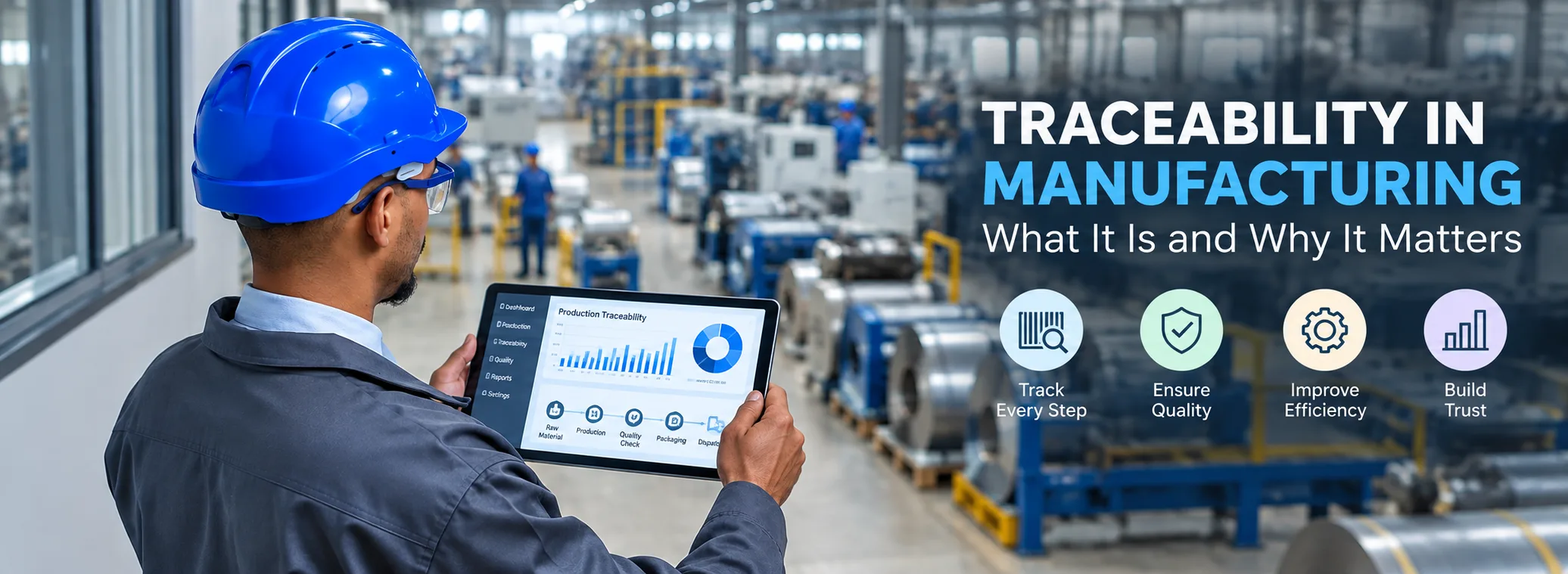
A defect surfaces in a finished product three weeks after it has shipped. The quality team needs to know which other units may be affected. With a well-designed traceability system, they can identify the relevant serial numbers, production line, shift, machine, and material lot within minutes.
This is the practical value of traceability in manufacturing. It connects products and components with the data generated throughout production, giving manufacturers a clearer view of where materials came from, how products were made, and where finished units were sent.
For manufacturers across the UAE and GCC, traceability can support quality management, faster investigations, inventory visibility, regulatory requirements, and more targeted responses when an issue is identified.
What Is Traceability in Manufacturing?
Traceability in manufacturing is the ability to track materials, components, work-in-progress, and finished products through different stages of production and distribution.
At its core, traceability answers two important questions:
- Where did this product or component come from?
- Where did it go after it entered the production process?
The system typically starts with a unique identifier, such as a batch number, lot number, barcode, RFID tag, or serial number. The system then links that identifier to relevant production events, including receiving, processing, inspection, assembly, storage, and shipment.
The level of tracking depends on the product and industry. Some manufacturers may need batch-level visibility, while others require individual serialisation for every finished unit.
Forward and Backward Traceability: Why Both Matter
Forward and backward traceability provide two views of the same production history. Using both gives quality and operations teams a more complete picture.
- Forward traceability starts with a raw material or component and follows where it was used. It can show which finished products contain a particular material lot.
- Backward traceability starts with a finished product and traces it back to its source, including the relevant material lot, supplier, machine, production stage, or shift.
For example, if a finished unit has a quality issue, backward traceability can help identify the production conditions and materials involved. Forward traceability can then identify other products made using the same material, process, or production conditions.
This combination lets manufacturers investigate issues with greater precision and focus their response on the products that need attention.
Lot-Level vs. Serial-Level Traceability
The right level of traceability depends on the product, risk profile, regulatory requirements, and operational needs.
| Approach | How It Works | Typical Use |
| Lot tracking | Products from the same production run share a common lot number. | Food, chemicals, consumer products, and other products where batch-level tracking is suitable. |
| Serial tracking | Every individual unit receives a unique identification number. | Medical devices, aerospace parts, automotive components, and high-value products requiring individual history. |
| Hybrid tracking | Raw materials may use lot numbers while finished products use individual serial numbers. | Manufacturers managing different traceability requirements across the same production process. |
Lot-level tracking can simplify implementation for high-volume production, while serialisation provides more detailed visibility at the individual product level. Many manufacturers combine both approaches based on the requirements of different materials, components, and finished products.
What Happens When a Defect Is Identified?
A production issue can quickly become an operational challenge when the relevant product history is difficult to reconstruct.
A typical investigation may involve:
- Identifying the affected product: A quality inspection or customer report highlights a potential issue.
- Tracing the production history: Teams review the product’s material, machine, process, shift, and inspection records.
- Identifying related units: Teams use the same production conditions or material lot to identify other potentially affected products.
- Defining the response: Quality and operations teams can determine whether specific units require inspection, rework, segregation, or another action.
- Documenting the outcome: The investigation and corrective actions become part of the product’s traceability history.
With connected production data, manufacturers can reduce manual investigation and make decisions based on a clearer record of what happened.
Why Traceability Matters for Manufacturing Compliance
Traceability also plays an important role in quality and regulatory management, particularly in industries where manufacturers must maintain documented production and product histories.
Requirements vary by sector, product, market, and regulatory framework. Pharmaceuticals, food and beverage, automotive, aerospace, medical devices, and defence can all have specific identification, documentation, or traceability expectations.
ISO 9001 also provides a broader quality management framework around identification and traceability where these controls are required.
For manufacturers, the practical goal is to maintain reliable records that can demonstrate:
- Which materials and components were used.
- Which production process or equipment was involved.
- When and where a product was manufactured.
- Which inspections or quality checks were completed.
- Where finished products were stored or dispatched.
A structured traceability system makes these records easier to capture, connect, retrieve, and review.
What Does a Manufacturing Traceability System Include?
A manufacturing traceability system usually combines several technologies and business applications rather than relying on a single piece of software.
The main components can include:
- Identification technology: Barcodes, RFID tags, QR codes, serial numbers, or direct part marking identify materials and products.
- Production data capture: Scanners, readers, sensors, and connected equipment capture information at key production stages.
- Manufacturing systems: MES or similar production applications record process and production events.
- ERP integration: ERP systems connect material, supplier, inventory, purchasing, and order information.
- Traceability software: A central system links identification data with production and movement records.
- Reporting and analytics: Dashboards and reports allow teams to review product history, exceptions, inventory, and other operational information.
The identification method should also suit the production environment. A barcode label may work well in a controlled warehouse, while RFID or direct part marking may be more suitable for products exposed to heat, abrasion, moisture, or frequent handling.
How RFID and Barcode Support Manufacturing Traceability
Barcode and RFID technology give manufacturers a simple way to identify and track materials, components, and products as they move through production.
- Barcodes work well for identifying individual items, batches, and locations through manual or fixed scanning.
- RFID can read multiple tagged items without direct line of sight, making it useful for faster and more automated tracking.
- The right choice depends on the product, production environment, and level of tracking required.
- Integration matters: Both technologies become more useful when their data connects with inventory, production, and business systems.
What Should Manufacturers Check Before Choosing a Traceability System?
Technology selection should follow traceability requirements, not the other way around. Before choosing a solution, manufacturers should consider:
- What needs to be tracked: raw materials, batches, components, work-in-progress, finished products, or all of these?
- What level of identification is required: lot, batch, or individual serial number?
- Which production stages need automated data capture?
- Will barcode, RFID, QR codes, direct marking, or a combination provide the best fit?
- How will the solution connect with existing ERP, MES, WMS, or other business systems?
- What reports and records will quality, operations, and compliance teams need?
- How will the system handle exceptions, rework, returns, and product movement?
Clarifying these requirements early makes it easier to design a traceability process that fits the actual production environment.
Bringing Traceability to UAE and GCC Manufacturing Operations
Manufacturing environments across the UAE and GCC can involve multiple production stages, warehouses, suppliers, distribution points, and connected systems. As these operations become more digital, linking production and product data becomes increasingly important.
DCS works with manufacturing organisations on RFID, inventory tracking, Industry 4.0, software, networking, and connected operational solutions. Its manufacturing offering includes RFID applications for pallet automation and industrial automation, as well as inventory tracking using barcode and RFID technologies.
DCS also offers a Product Traceability & Warranty Management System that uses unique serial numbers and QR codes to capture product information across stages such as production, palletisation, charging, store receipt, and pre-delivery inspection. The system is currently positioned for battery manufacturers and distributors, making it particularly relevant to organisations that require unit-level product visibility.
Why Manufacturers Choose DCSME for Traceability
DCSME brings together data capture technologies, software, integration, and implementation capabilities for connected manufacturing environments:
- DCS combines barcode, RFID, IoT, sensors, wireless, and other data capture technologies across operational environments.
- Its manufacturing solutions include RFID applications for pallet automation and industrial automation.
- DCS provides inventory tracking solutions using barcode and RFID technologies.
- Its Industry 4.0 solutions connect machines, data, and operational processes to support real-time decision-making and process optimisation.
- DCS provides software, implementation, configuration, integration, and ongoing support for operational requirements.
- Its solutions can integrate with existing enterprise applications, operational platforms, and connected devices.
This combination allows manufacturers to approach traceability as part of a wider digital manufacturing strategy rather than as a standalone tracking system.
Final Thoughts
Manufacturing traceability brings together product identification, production data, inventory movements, and system records to create a clear history of materials and finished products. As we discussed, manufacturers can use lot-level or serial-level tracking depending on their products and operational requirements, while technologies such as barcode and RFID make data capture more efficient. When connected with ERP, MES, inventory, and Industry 4.0 systems, this information can support faster investigations, better quality control, and more informed operational decisions.
For manufacturers in the UAE and wider GCC, the right approach depends on the production environment, traceability requirements, and existing technology infrastructure. DCS brings together RFID, barcode, inventory tracking, product traceability, software integration, and Industry 4.0 capabilities to build connected solutions around these requirements. With the right combination of technology and process design, manufacturers can turn traceability data into a practical tool for improving visibility, quality, and operational control.
Frequently Asked Questions
What is the difference between traceability and quality control?
Quality control checks whether a product meets defined specifications. Traceability records the history of that product, material, or component, allowing teams to investigate where it came from, how it was processed, and where it moved.
Do small manufacturers need traceability?
The required level of traceability depends more on the product, industry, customer requirements, and applicable regulations than on company size. A smaller manufacturer may need a focused system covering specific materials, batches, or finished products.
Can traceability be added to an existing production line?
Yes. Manufacturers can introduce traceability in phases, starting with one production line, product category, or process. This allows the identification method, data capture, and system integration to be tested before wider deployment.
Is RFID always better than barcode for manufacturing traceability?
The best option depends on the application. Barcodes are practical for many high-volume identification processes, while RFID can support automated and bulk identification where non-line-of-sight reading is valuable. Some manufacturing environments use both technologies.
What information can a manufacturing traceability system capture?
Depending on the system design, traceability data can include material lots, serial numbers, suppliers, machines, production stages, inspection results, operators, timestamps, inventory movements, and shipment information.
How quickly can a manufacturer trace an affected product or batch?
The response time depends on the quality and integration of the traceability system. A well-connected system can make relevant product and production records available much faster than manual reconciliation across spreadsheets, paper records, and separate systems.
Can traceability support Industry 4.0 initiatives?
Yes. Traceability can form part of a broader Industry 4.0 environment by connecting product identification, machine data, production processes, inventory systems, and analytics. DCS’s Industry 4.0 solutions focus on connected technologies, real-time data, automation, and data-driven manufacturing operations. DCS Industry 4.0 Solutions
