

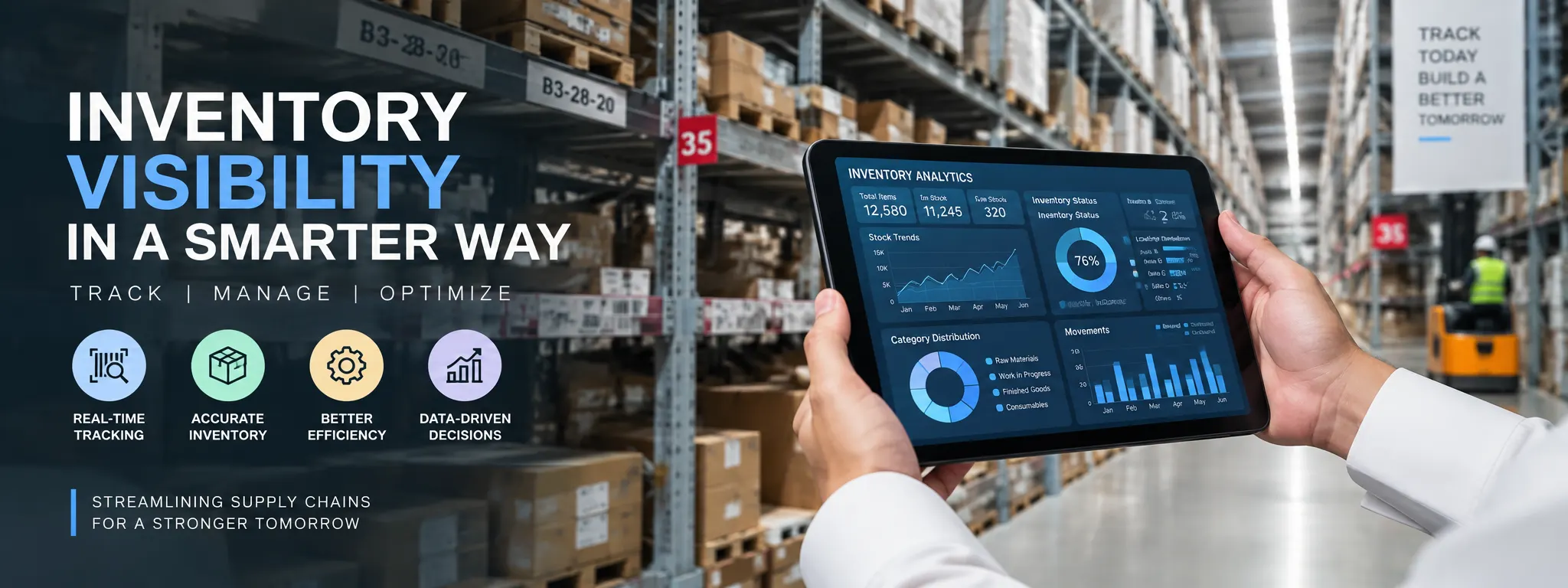
Inventory control methods are the rules a business uses to track stock and decide when to reorder. The main categories are prioritization methods like ABC analysis, ordering methods like EOQ and JIT, and tracking technologies like barcode and RFID. Only 6% of companies report full supply chain visibility, which is why the technology layer matters as much as the method itself.
Key Takeaways
- Inventory control methods split into three groups: prioritization, ordering, and tracking. Most warehouses combine methods from each group rather than relying on one.
- ABC analysis and FSN classification help businesses focus attention where it actually drives revenue or carries risk.
- EOQ and JIT control when and how much to order. Safety stock and reorder points protect against demand spikes and supply delays.
- Barcode and RFID turn a written method into a real-time inventory control system. Without one, accuracy tends to stay well below what a growing operation needs.
What Are Inventory Control Methods?
Inventory control methods are the rules a business applies to manage stock levels from arrival to shipment. Some methods prioritize which items need more attention. Others calculate when and how much to reorder. A third group, the technology layer, records what is on the shelf in real time.
DCS’s Warehouse Management System combines all three layers into one platform. Prioritization rules and tracking technology feed the same inventory record, so nothing runs in a silo.
Types of Inventory Control Systems: Periodic vs Perpetual
Two fundamental types of inventory control systems exist. A periodic system counts stock at set intervals. A perpetual system updates records continuously as items move.
A periodic system relies on manual counts done monthly, quarterly, or annually. It costs little and needs no special software. The downside: records go stale the moment a sale happens between counts. 43% of small businesses still track inventory manually or not at all, which explains why accuracy problems persist even at businesses that know their stock matters.
A perpetual system updates stock the instant an item is received or sold. This usually runs through barcode or RFID scans feeding a central platform. DCS’s barcode inventory system is one route from periodic to perpetual without a full infrastructure overhaul.
Inventory Control Methods for Prioritizing Stock
Prioritization methods sort inventory by value or movement speed so a business focuses effort where it matters. ABC analysis and FSN classification dominate this category.
ABC analysis groups items into three tiers. A-items are high-value and low-quantity, and they get the tightest control. B-items sit in the middle. C-items are low-value and high-quantity. Reducing stock-outs and overstocks through better prioritization can lower inventory costs by 10%, per Zebra’s retail research, which is why ABC analysis stays standard practice.
FSN classification groups items by movement speed instead: fast, slow, and non-moving. This matters most for warehouse layout. Placing fast-moving items in easy-to-reach locations cuts travel time across every shift. DCS’s AIDC approach ties classification directly to the scanning layer, so a reader knows each item’s category the moment it is picked.
Inventory Control Techniques for Timing and Ordering
Ordering techniques answer a different question than prioritization. Not what matters most, but when and how much to order. EOQ and JIT are the two most common inventory control techniques here.
EOQ is a formula calculating the order quantity that minimizes holding and ordering costs together. It works best for products with steady, predictable demand. When demand fluctuates heavily, EOQ’s core assumption breaks and the output becomes unreliable.
JIT takes the opposite approach. Goods arrive only as needed, cutting the capital tied up in storage. It reduces holding costs sharply, but removes the buffer against a late shipment or sudden spike. Most businesses running JIT pair it with a safety stock policy for that reason.
Safety stock and reorder points work alongside both methods. Safety stock is a buffer against demand surges or supply delays. A reorder point triggers replenishment automatically once stock falls to a set level. 91% of consumers say they are less likely to return after experiencing a stockout, making reorder timing a retention issue, not just logistics.
FIFO and Batch Tracking for Traceability
FIFO and batch tracking solve a traceability problem, not a cost problem. Both answer which specific units of stock are moving, not just how many.
FIFO ensures the oldest stock sells before newer stock reaches the pick face. It matters most for perishable goods and anything with an expiration date. Food, cosmetics, and pharmaceuticals rely on FIFO almost universally.
Batch tracking monitors inventory by lot number as it moves through the supply chain. A batch number lets a business trace a production run to its source during a recall. DCS’s Product Traceability and Warranty Management System handles this at the unit level, linking each item to its batch and its movement history.
Inventory Control Systems and Technology
Inventory control systems depend on the technology capturing the data. Barcode, RFID, and IoT sensors turn a written rule into a real-time system a team can rely on.
Barcode scanning is the most common starting point. It is cheap and works with equipment most warehouses already own. One study found barcode technology reduced human error by 43.5% in a medication tracking application, a result that holds across high-volume industries.
RFID extends barcode scanning by removing the line-of-sight requirement. A reader captures dozens of tagged items in one pass, which matters at dock doors and sorting lines. DCS’s RFID explainer covers where the technology earns its higher cost.
Running both technologies together delivers the most value for most operations. DCS’s RFID versus Bluetooth guide covers matching the right carrier to each checkpoint. At dock doors specifically, DCS deploys fixed industrial scanners that capture every item without manual scanning.
How Better Visibility Changes Inventory Accuracy
58% of retail brands and manufacturers operate below 80% inventory accuracy, and that gap cascades directly into fulfillment errors and complaints. Inventory accuracy across U.S. retail sits around 63% today, tracking closely with how many businesses still rely on manual methods.
Choosing the Right Inventory Control Methods
The right combination of inventory control methods depends on four factors specific to the business. Getting this wrong usually means running a method built for a different scale of operation.
- Inventory size and turnover. High-turnover businesses benefit most from perpetual systems paired with FIFO or EOQ for ordering.
- Product variability. A diverse product mix needs ABC analysis and FSN to keep prioritization manageable across categories.
- Order frequency. Frequent, high-volume orders justify JIT and automated reorder triggers over manual review.
- Technology access. A business already running barcode or RFID should lean into perpetual, real-time tracking over periodic counts.
How DCS Builds Inventory Control Systems for GCC Warehouses
DCS combines barcode, RFID, and IoT into one platform rather than treating tracking as separate from the method it supports. Prioritization rules, ordering logic, and physical tracking all feed the same record through one Warehouse Management System.
DCS’s IoT asset tracking extends visibility beyond the warehouse walls, keeping stock current across ports, warehouses, and retail locations. A GCC distributor working with DCS moved from periodic manual counts to perpetual barcode-based tracking, cutting the discrepancies its team found during quarterly reconciliation.
Want to see which inventory control methods fit your warehouse? Talk to DCS.
Common Inventory Control Mistakes to Avoid
- Choosing one method for the whole operation. Prioritization, ordering, and tracking solve different problems and usually need to run together, not compete.
- Staying on periodic counts too long. Growing order volume makes manual counts fall behind reality faster than most teams expect.
- Applying EOQ to unpredictable demand. The formula assumes steady consumption and produces unreliable quantities without that assumption holding.
- Treating barcode and RFID as competing choices. Most warehouses get more value running both at different checkpoints than picking one exclusively.
Frequently Asked Questions
What is the difference between inventory control and inventory management?
Inventory control focuses on tracking and regulating stock levels so records match physical reality. Inventory management is the broader function that covers control alongside demand forecasting, supplier negotiation, and supply chain planning.
Which inventory control method is best for a small business?
Small businesses with low turnover often start with a periodic system and FIFO. Both are simple to run without specialized software. As order volume grows, most move toward perpetual tracking with barcode scanning.
Can multiple inventory control methods be used together?
Yes, and most operations do exactly this. A typical setup uses ABC analysis for prioritization, EOQ for ordering, and barcode or RFID for real-time tracking, all running at once.
Does RFID replace the need for methods like ABC analysis?
No. RFID is a tracking technology, not a prioritization or ordering method. It makes ABC analysis and cycle counting more accurate, but it does not replace the decision logic those methods provide on their own.
How often should cycle counting be done under a perpetual system?
Frequency depends on item value and movement speed. A-items from an ABC analysis typically get counted weekly or monthly. C-items often only need quarterly checks, since the cost of a discrepancy is lower.
Talk to DCS About Inventory Control for Your Warehouse
The right inventory control methods depend on what a business stores, sells, and moves. There is no single template that works for every operation. Contact DCS to see how barcode, RFID, and warehouse management technology can support the methods your operation already relies on.
